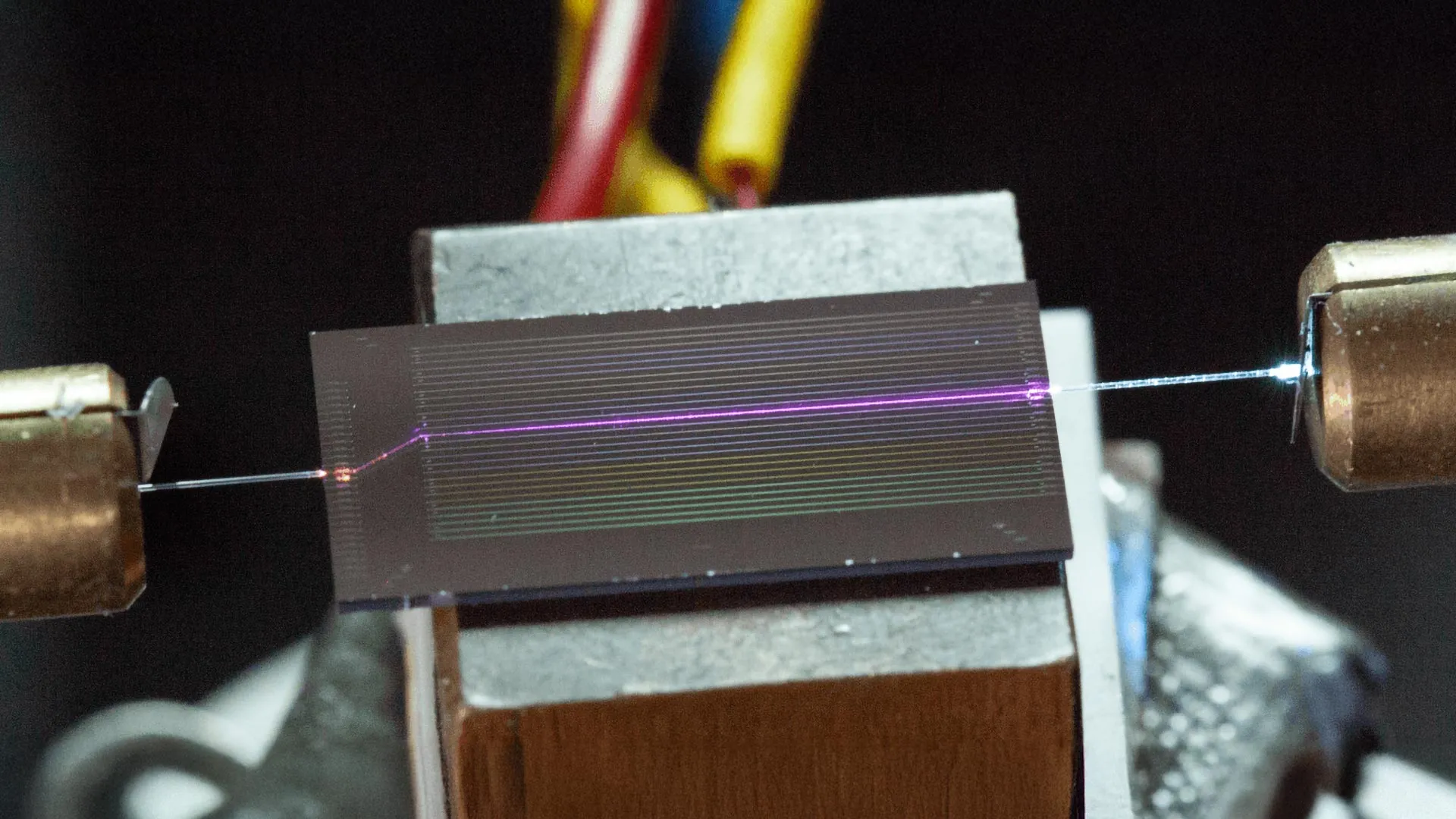
SummaryThe Lončar lab at Harvard University used a new 'side-wall poling' technique to generate 4.2 mW of ultraviolet (UV) light at a 390 nm wavelength on a thin-film lithium niobate photonic chip. Achieved by frequency-upshifting red light, this output is approximately 120 times greater than that of previous similar devices. Published in Nature Communications, the study positions this chip as a potential building block for compact trapped-ion quantum computers, atomic clocks, and environmental sensors. |
Why it mattersTrapped-ion quantum computers require near-UV laser sources for specific atomic transitions. Integrating these sources onto a photonic chip is a prerequisite for moving beyond rack-sized systems. The 120-fold power increase compared to previous best results suggests that on-chip UV generation is transitioning from a proof-of-concept stage to a practically usable component. Since the same wavelength range is also used for atomic clocks and greenhouse gas detection, the impact extends beyond quantum computing. |
Highlights- Side-wall poling places metal 'finger' electrodes approximately 50 nm next to the etched waveguide with high precision. This method eliminates the traditional trade-off between poling quality and electrode proximity.
- The 120-fold gain is measured against a very low baseline of only a few tens of microwatts. Therefore, the absolute output power (4.2 mW) remains modest by classical laser standards.
- Co-first author Kees Franken explicitly notes that 'other nonlinear effects,' which are not yet fully understood, are also occurring in the device.
|
Critical takeThe '120×' figure in the headline is technically correct but somewhat misleading. This ratio is achieved by comparing against an extremely weak previous result (tens of µW). The 4.2 mW UV output is still far from the watt-level powers required for a full trapped-ion system. Consequently, the chip is merely a small part of a much larger integration challenge. Additionally, the news item is not independent reporting but rather a ScienceDaily press release. The quantum computing application remains speculative; no quantum processor has yet been demonstrated using this chip. |
This critique was written by the local AI model
Qwen3.8-27B. I chose the story; I do not review each critique before it is published.