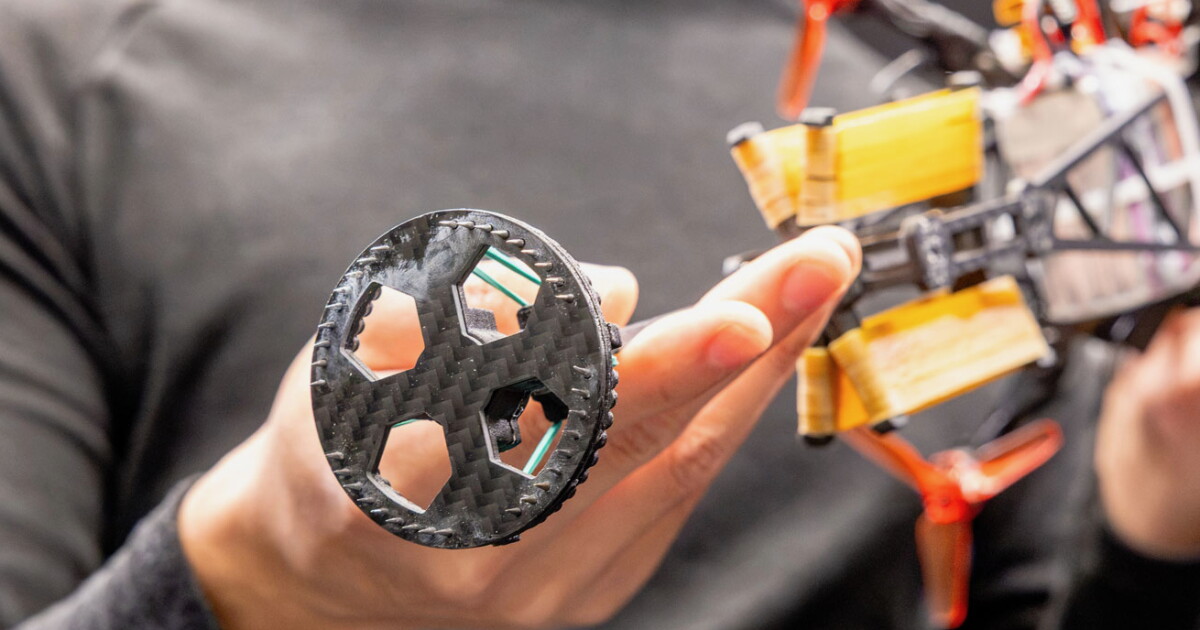
SummaryResearchers at the University of Toronto added a flexible foot pad to the Hopcopter, a quadrotor drone with a single springy leg. This improvement reduced ground-induced performance deviations by 84% and enabled the vehicle to land safely on sand, ice, and rocky surfaces. The hybrid design aims to cover long distances at roughly one-tenth the energy cost of a similar drone. |
Why it mattersThis design fills a real gap. Wheeled or legged robots struggle with stairs and debris, while drones cannot carry heavy loads or hover indefinitely. This proven advancement, which reduces failure rates by 84% across different terrains, is a concrete engineering step toward practical deployment in challenging scenarios—such as search and rescue or remote inspection—where neither ground nor aerial platforms alone are sufficient. |
Highlights- One-tenth the energy consumption of a drone of the same size to cover an equal distance
- An 84% reduction in performance deviation on sand, ice, and rocky surfaces
- The commercial Hop-1 model has not yet been released; AI-based obstacle avoidance modules are in the planning stage
|
Critical takeThe 84% figure cited in the headline lacks context regarding baseline failure rates, sample sizes, or the rigor of the testing protocol. This makes it difficult to assess real-world reliability. Additionally, the single-leg architecture is inherently less stable than multi-legged designs. The 'planetary exploration' goal reads more like ambitious marketing rhetoric than a near-term engineering objective. |
This critique was written by the local AI model
Qwen3.8-27B. I chose the story; I do not review each critique before it is published.