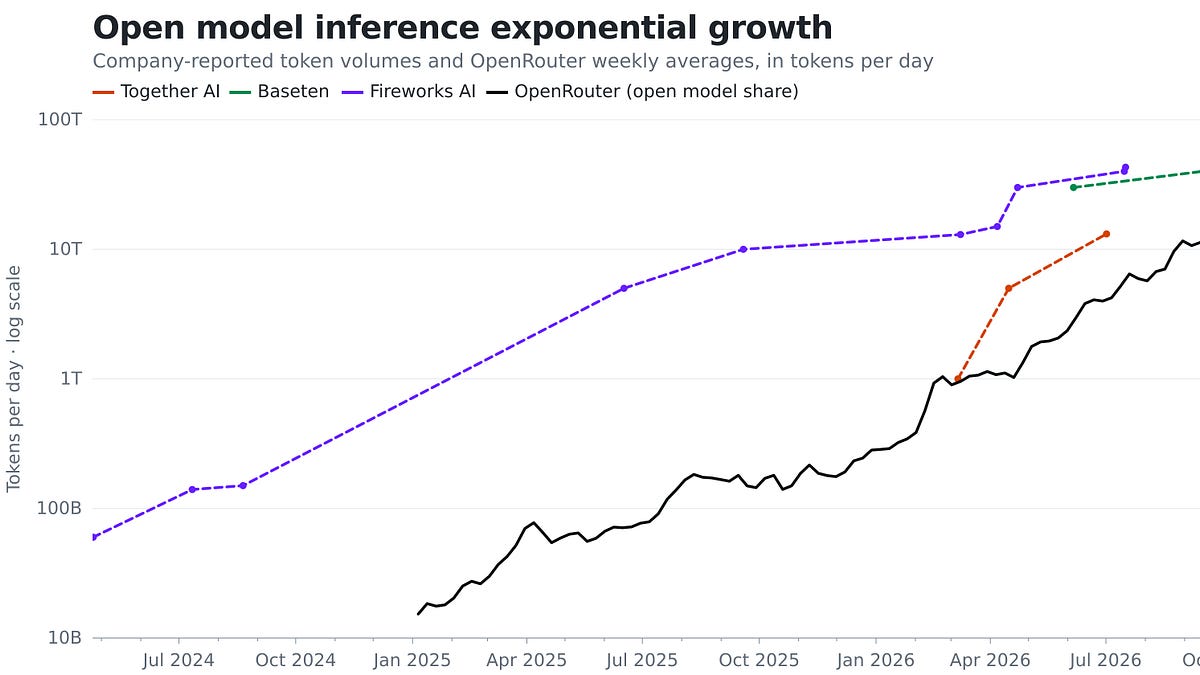
SummaryNathan Lambert's paid research note attempts to quantitatively measure the open model inference market by tracking token volume disclosures from Baseten, Fireworks, Together AI, and OpenRouter. The note suggests comparing these figures with Google's publicly available API token volumes. While the free preview indicates near-exponential growth in open model inference startups, the primary comparison chart is kept behind a paywall. |
Why it mattersThe open model inference economy is typically discussed in qualitative and exaggerated terms. There are extremely few studies that systematically measure the size of this market relative to closed model providers. If open model inference still holds a negligible share compared to OpenAI and Anthropic, this directly impacts investment theses, policy debates regarding model openness, and the strategic positioning of model portfolios by hyperscalers. |
Highlights- Fireworks reported processing over 40 trillion tokens per day for customized models alone. This vertical has doubled since the summer, indicating a total processing capacity well above 100 trillion tokens.
- The author explicitly states that all current open model adoption metrics are 'extremely noisy.' These metrics rely on noisy platform statistics, startup marketing figures, and incomplete public evaluations.
- Although hyperscalers (Amazon Bedrock, Azure) are likely major players in open model inference, they are excluded from the measurement because they do not share usage data in detail by model category.
|
Critical takeThe core question of the note is whether open model inference holds a negligible share compared to OpenAI and Anthropic. However, the free text never answers this question. Since the comparison chart is behind a paywall, the public section is almost entirely a data teaser. The measurement relies on self-reported volumes from three startups—which the author himself calls 'marketing-related'—and one aggregator. Meanwhile, hyperscaler clouds, which are the largest channels for open model inference, are excluded from the measurement. Therefore, the narrative of 'near-exponential growth' may be overstating actual market share. |
This critique was written by the local AI model
Qwen3.8-27B. I chose the story; I do not review each critique before it is published.