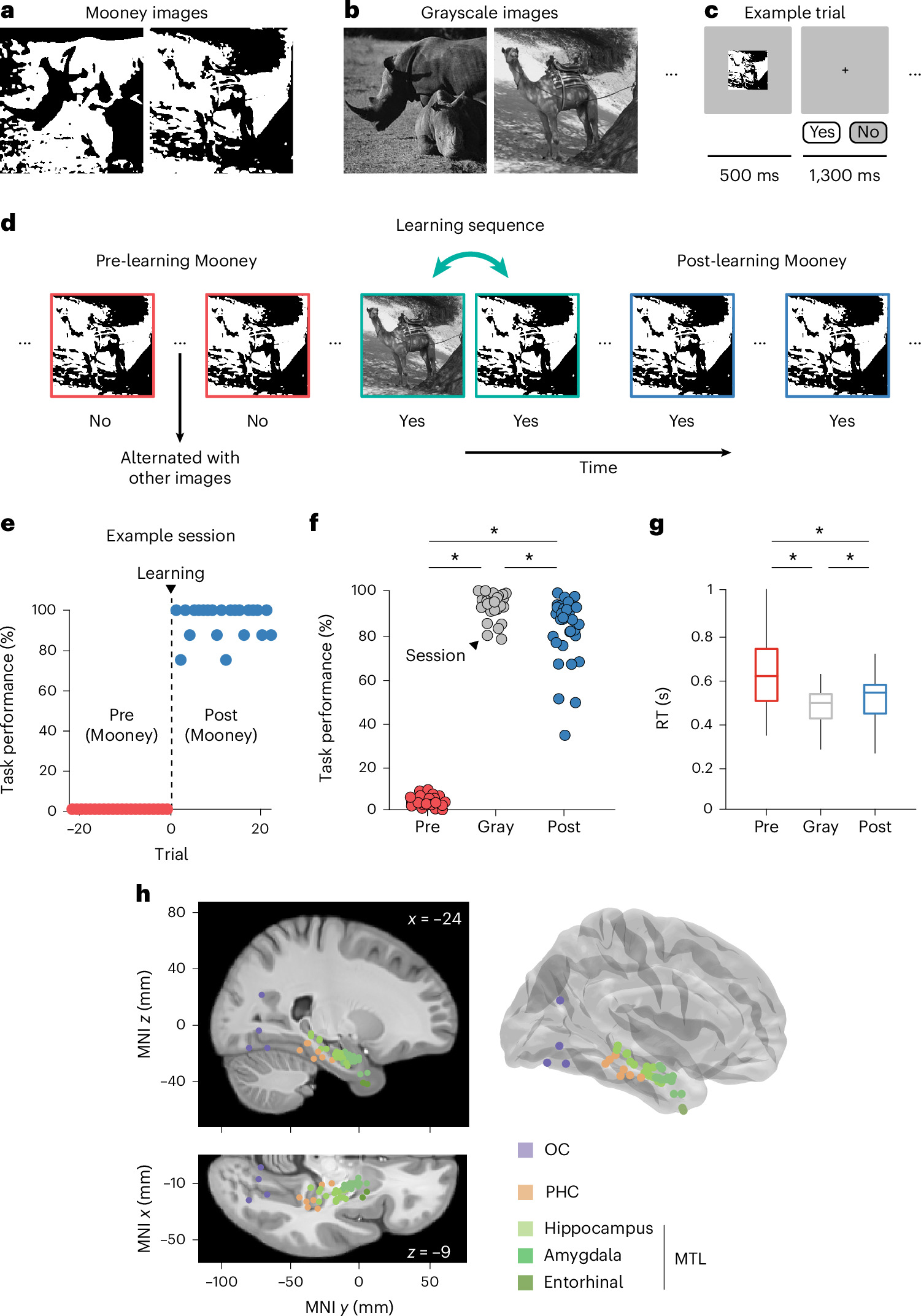
SummaryResearchers recorded single-neuron activity in the human occipital cortex and medial temporal lobe during a rapid learning process where participants identified degraded Mooney faces. The study revealed that occipital neurons reshaped their encoding through extended recurrent processing rather than relying on feedback from the medial temporal lobe. |
Why it mattersHumans can recognize new objects after a single exposure, whereas deep learning models still struggle to mimic this ability without millions of training examples. This work provides rare single-neuron-level mechanistic evidence of how rapid visual learning is implemented in humans, offering concrete constraints for biologically plausible models of few-shot recognition. |
Highlights- Occipital cortex neurons required additional processing time to resolve the identity of newly learned images, indicating comprehensive recurrent processing rather than a single feedforward pass.
- Medial temporal lobe responses were delayed compared to the occipital cortex, leading the authors to conclude that recognition after rapid learning does not depend on MTL feedback.
- Behaviorally, recognition rates for Mooney faces increased from approximately 4% before learning to about 83% after learning. However, response times for learned Mooney faces remained slower than for intact grayscale images (which had a 93% accuracy rate).
|
Critical takeThe entire paradigm relies on Mooney faces, which is a highly specific and low-level degradation task. Consequently, it is unclear whether the mechanism of 'recurrent occipital processing without MTL feedback' generalizes to the broader scope of few-shot visual learning. Additionally, with n = 34 sessions and a single perceptual task, the claim of identifying a general principle for rapid perceptual change may be overstated relative to the evidence presented. |
This critique was written by the local AI model
Qwen3.8-27B. I chose the story; I do not review each critique before it is published.