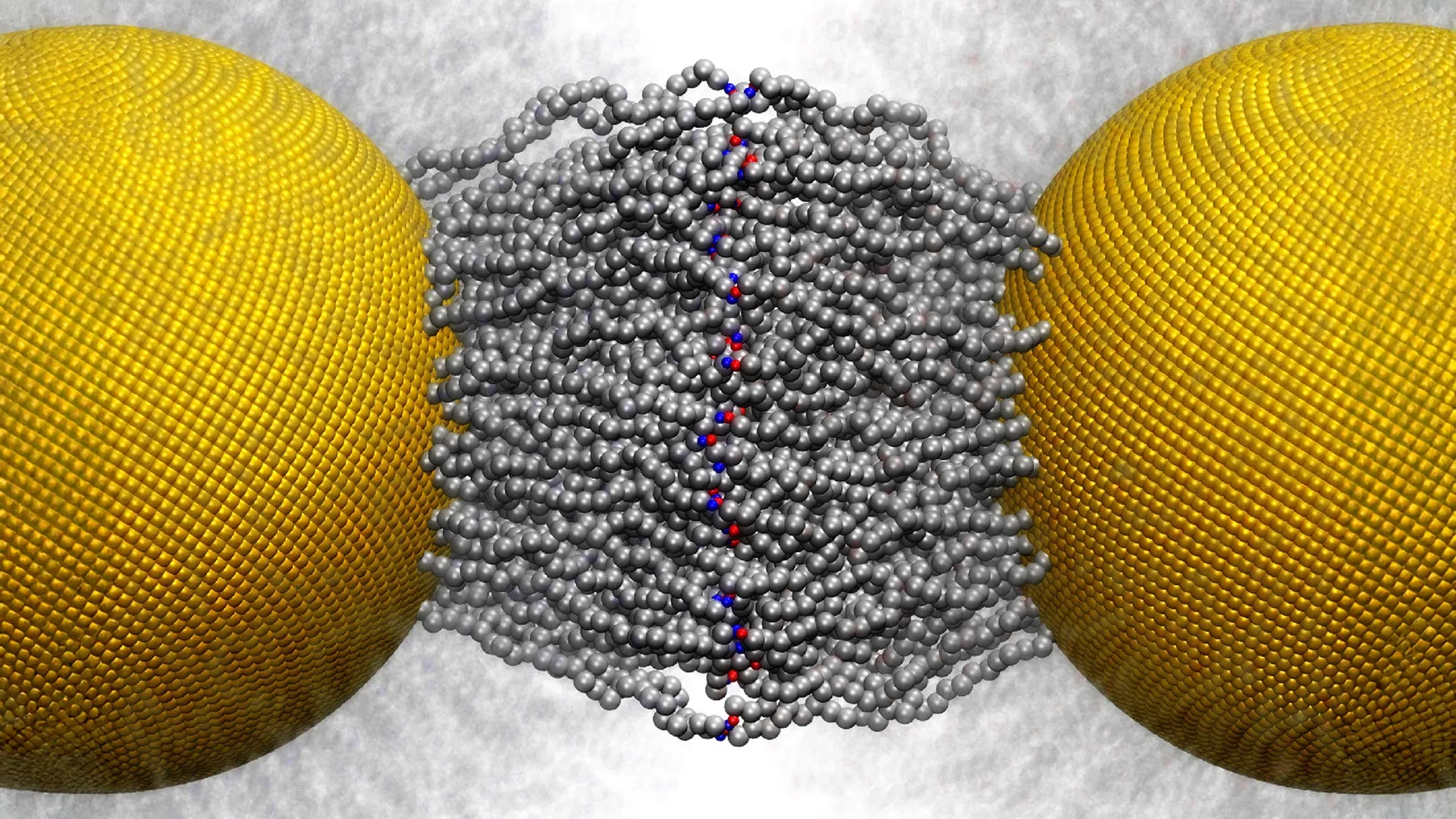
SummaryMIT researchers have demonstrated that highly flexible, charged molecular ligands can spontaneously organize nanoparticles into previously unobserved crystal structures. This finding directly refutes the assumption, held by the field for two decades, that rigid linkers are a prerequisite for controlled nanoparticle assembly. |
Why it mattersThis is significant because it offers a simpler and more universal pathway for designing nanoparticle superlattices. The properties of these materials are determined by their atomic-scale arrangement. If flexible ligands can reliably produce new structural families, it could accelerate the development of specialized materials in photonics, catalysis, drug delivery, and energy storage. This development also reduces the need for specialized synthesis methods tied to a single limiting condition. |
Highlights- Contrary finding: For controlled nanoparticle assembly, the maximum flexibility of the ligand, rather than rigidity, is the determining factor
- Charge-driven self-organization replaces direction-specific synthesis design
- Published in Nature Materials; the team includes researchers from MIT and the University of Delaware
|
Critical takeThis text reads like a press release rather than a peer-reviewed analysis. It does not provide a quantitative comparison of structural diversity or performance metrics relative to existing rigid ligand methods. Consequently, the claim of 'previously unseen' structures relies entirely on the authors' own assessment, without independent benchmarking. |
This critique was written by the local AI model
Qwen3.8-27B. I chose the story; I do not review each critique before it is published.