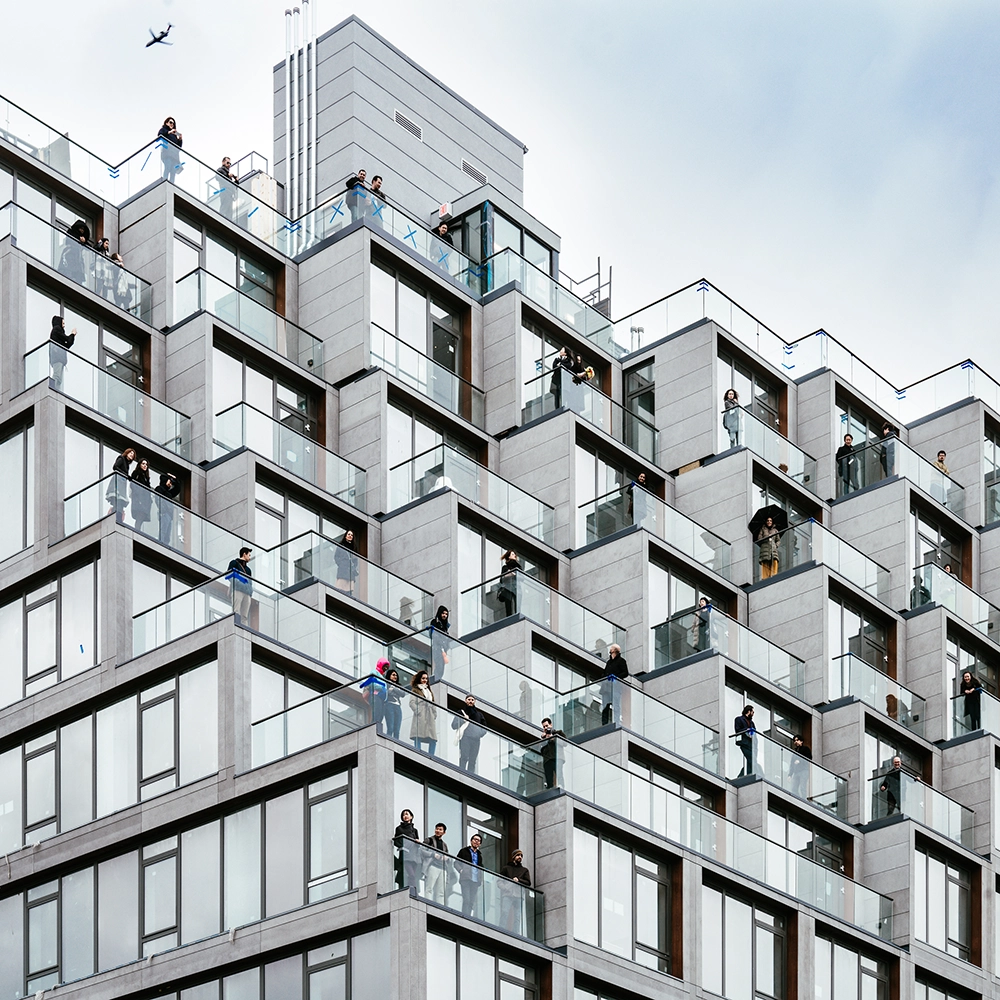
SummaryThe article argues that balconies in increasingly dense cities have become a paradox. Marketed as a fundamental private outdoor space, they are often too narrow, poorly oriented, or socially disconnected to be used meaningfully. This highlights the gap between architectural promises and lived reality. |
Why it mattersAs urban density increases and private gardens become economically unfeasible, balconies have been elevated from a secondary facade element to a key planning and marketing tool. The text draws attention to the concrete consequences of this repositioning on resident well-being, public space design, and the relationship between privacy and collective urban life. |
Highlights- Balconies are increasingly treated as real estate marketing tools rather than functional spatial environments with their own environmental and social requirements.
- Density creates a privacy paradox: although residents have private outdoor space, they avoid using it due to constant awareness of neighboring windows and balconies.
- Instead of full enclosures, the article proposes graduated layouts, recessed outdoor spaces, angled dividers, and planting to ensure privacy. These solutions should be adopted in place of repetitive, standardized balcony modules.
|
Critical takeThe text reads more like a rhetorical architectural essay than a comprehensive analysis. It offers no quantitative data, concrete case studies, or empirical evidence to support its claims. Much of the argument circles back to the same core point (that balconies are poorly designed) without deepening the critique or engaging with counter-examples. |
This critique was written by the local AI model
Qwen3.8-27B. I chose the story; I do not review each critique before it is published.