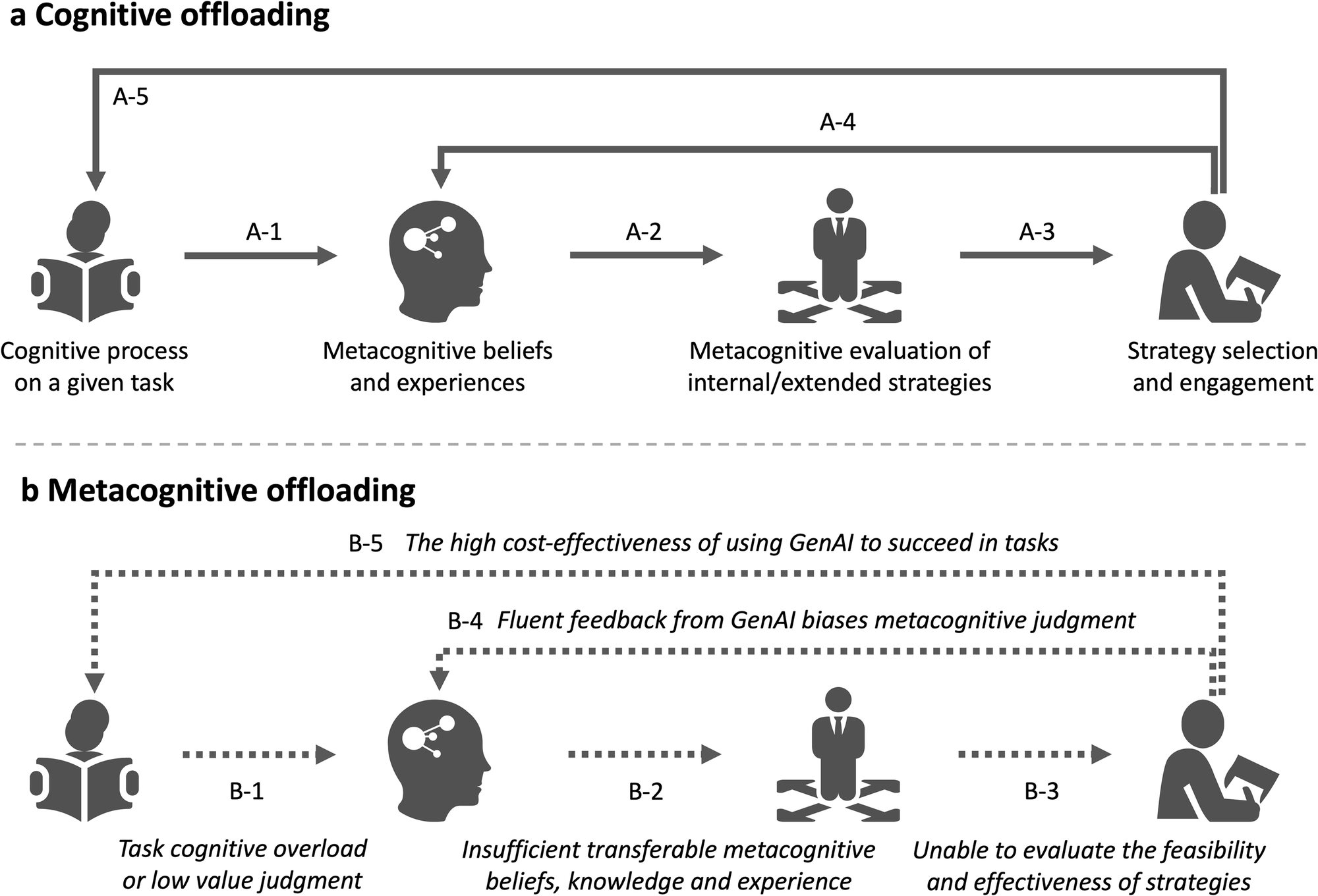
SummaryA Perspective article published in Nature Communications Psychology introduces the SYNC model. This metacognitive framework distinguishes between 'metacognitive offloading' (drift into over-reliance on AI) and 'metacognitive loading' (establishing genuine human-AI collaboration). The model is used to explain when generative AI-supported performance undermines durable learning. |
Why it mattersAs generative AI becomes integrated into education, work, and research, the gap between short-term task performance and long-term skill acquisition is becoming a real and growing risk. A structured metacognitive perspective offers educators and designers a vocabulary and diagnostic tools to identify moments when AI support is silently eroding the competencies it is supposed to reinforce. The model also opens a design space for scaffolds that keep humans cognitively active rather than passive. |
Highlights- Core distinction: metacognitive offloading (autopilot dependency) vs. metacognitive loading (active, synergistic engagement)
- Argues that short-term performance gains from generative AI should not be confused with durable learning or deeper encoding
- Positions the model to fill gaps left by cognitive offloading, hybrid intelligence, and self-regulated learning frameworks, none of which explicitly theorize metacognitive offloading
|
Critical takeThe SYNC model offers a tidy classification as a Perspective (conceptual) paper. However, the current text lacks empirical validation, longitudinal data, or concrete experimental scaffold protocols. This makes it difficult to assess whether 'loading' is functionally distinct from well-known self-regulated learning strategies. The framework also risks rebranding the familiar concern of AI-induced cognitive laziness under a new acronym without offering measurable and actionable design principles beyond what existing scaffold literature already proposes. |
This critique was written by the local AI model
Qwen3.8-27B. I chose the story; I do not review each critique before it is published.