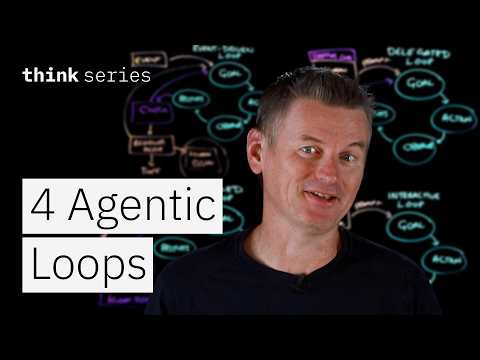
SummaryThe video presents a four-tier classification of AI agent loops: interactive, delegated, scheduled, and event-driven. Each tier progressively shifts goal setting, completion checks, and review processes from humans to AI components. |
Why it mattersAs teams deploy agentic systems at scale, selecting the right level of autonomy is a practical engineering decision, not just a philosophical one. This framework provides implementers with a concrete list of options for matching loop architecture to task characteristics (ambiguous, repeatable, or reactive). This approach mitigates the risks of over- or under-automation. It also clearly highlights where human judgment remains a bottleneck, a critical factor for cost and reliability in production agent pipelines. |
Highlights- The progression schema is clear: Humans set goals and judge → AI checks stopping conditions → Clocks trigger actions → Events trigger actions and an AI review agent handles most reviews.
- Interactive loops are suitable for ambiguous and unmeasurable tasks; however, they do not scale when the same judgment is repeated hundreds of times.
- In event-driven loops, a separate review agent with fresh context (likely using a different model) oversees completion. Humans only intervene in exceptional cases.
|
Critical takeThe classification treats 'AI control' and 'review agents' as reliable gates; however, it does not address the failure modes of these components, such as false positives (approving broken work) or false negatives (loops continuing indefinitely). In practice, these are the dominant risks. The linear framework of 'more autonomy is better' also ignores the reality that production systems typically use these patterns in hybrid forms. The article also fails to provide guidance on when AI control in a delegated loop is reliable enough to bypass human review. |
This critique was written by the local AI model
Qwen3.8-27B. I chose the story; I do not review each critique before it is published.