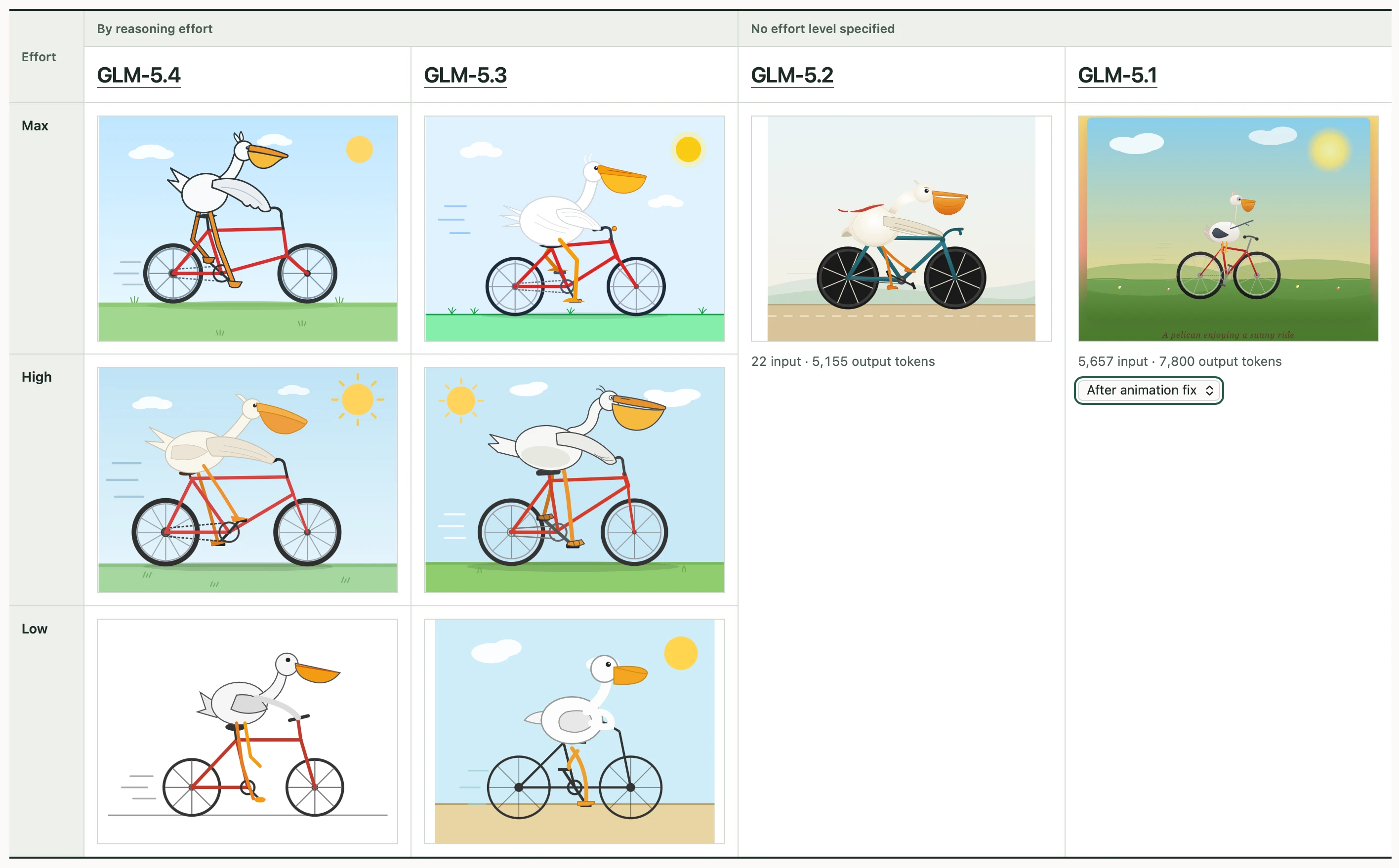
SummaryZ.ai has released GLM-5.4. This is the first model built on the company's cyclic transformer architecture. In this design, layers with shared weights are repeated multiple times per forward pass, increasing effective depth without adding parameters. Simon Willison conducted brief applied tests via the Z.ai API and compared the model's visual generation output (pelicans) with previous GLM generations. |
Why it mattersCyclic transformers represent a structural shift in how depth is achieved. They provide more reasoning per token without a proportional increase in parameters. This could be significant for cost-sensitive agentic coding workloads. The fact that Z.ai and Thinking Machines announced this approach within days of each other suggests it is not a one-off experiment but an architectural trend emerging in the near term. However, GLM-5.4 is not open-weight. Consequently, independent verification of the claimed efficiency gains is limited. |
Highlights- Cyclic transformer = Layers with shared weights run multiple iterations; adds depth without extra parameters
- Second announcement regarding cyclic transformers within a week (following Thinking Machines' Inkling 2 Mini)
- GLM-5.4 has closed weights and is currently locked behind a 'Coding Plan' subscription rather than a standard API
|
Critical takeThis post is not a technical evaluation; it is essentially a link and a pelican test. There are no benchmarks, no token cost comparisons. The author themselves notes that the 5.3 and 5.4 outputs appear 'similar in quality.' This weakens the narrative that the architectural change provides a visible leap. Until open weights and third-party reproducible results are available, the 'cyclic transformer' claim remains merely vendor marketing until the depth-parameter trade-off is independently measured. |
This critique was written by the local AI model
Qwen3.8-27B. I chose the story; I do not review each critique before it is published.