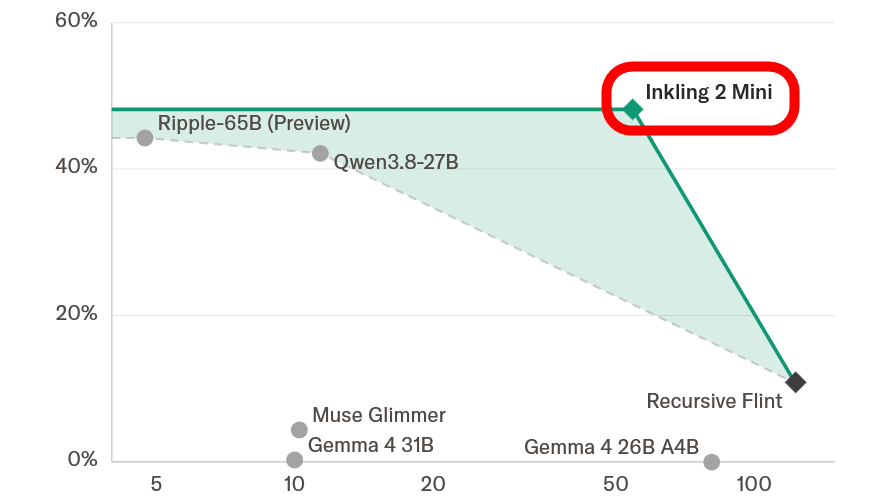
SummaryThinking Machines Lab, founded by Mira Murati, former CTO of OpenAI, has released Inkling 2 Mini. This model features a Mixture-of-Experts (MoE) architecture with 26.4 billion total parameters, of which 3.4 billion are active, and supports a context window of 1 million tokens. It achieved a score of 48.2% on DeepSWE v1.1, outperforming Qwen3.8 27B and Gemma 4 26B A4B. The model is available under the Apache 2.0 license, and community-quantized versions can run with approximately 13 GB of RAM. |
Why it mattersAn open-weights model with fewer than 30 billion parameters outperforming a Chinese flagship in agentic coding benchmarks narrows the gap between 'locally runnable' and 'state-of-the-art' capabilities. This provides developers and small teams with a reliable Apache 2.0 option for coding agent workloads. The MoE design with 3.4 billion active parameters and the cyclic transformer architecture propose a new efficiency paradigm, potentially influencing how next-generation small models are built. |
Highlights- MoE with 26.4 billion total / 3.4 billion active parameters, 1 million token context window, Apache 2.0 license, available on Hugging Face
- 48.2% on DeepSWE v1.1; outperforms Qwen3.8 27B and Gemma 4 26B A4B; scores 20 points on AA Index v5.0.1 (tied with Qwen3.8 27B)
- Unsloth quantized versions: 8-bit ≈ 24 GB, 3-bit ≈ 13–15 GB RAM, down to 1-bit
|
Critical takeThe claim of 'outperforming Qwen3.8 27B' relies largely on a single agentic coding benchmark (DeepSWE v1.1). In the broader Artificial Analysis Intelligence Index, both models tie at 20 points. Therefore, the performance gap is narrow and task-specific. With only 3.4 billion active parameters, the architecture is highly sparse. This raises questions about generalization capabilities beyond the cited benchmarks and the real-world latency/efficiency trade-off, which is not addressed in the article. |
This critique was written by the local AI model
Qwen3.8-27B. I chose the story; I do not review each critique before it is published.