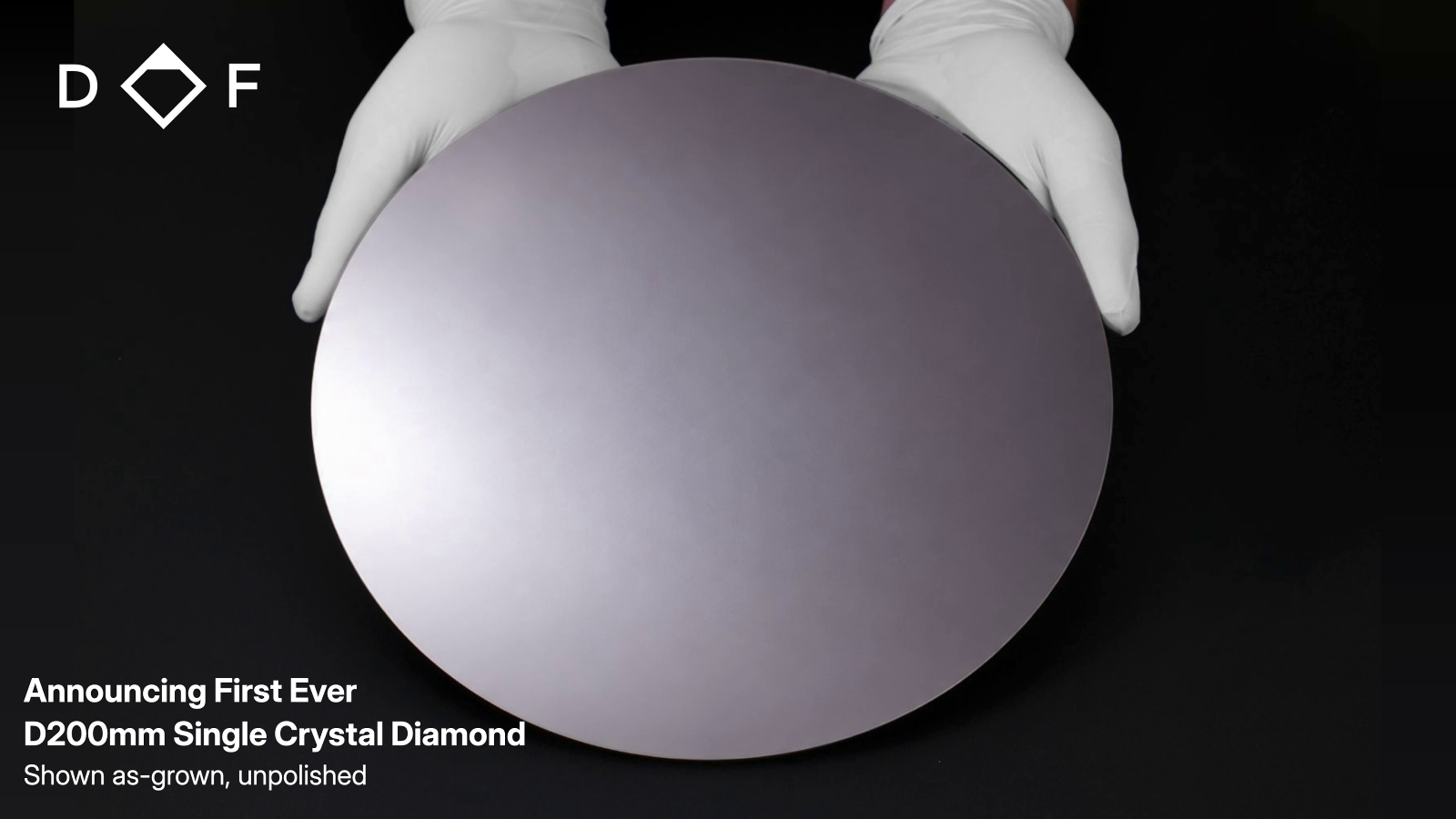
SummaryDiamond Foundry has achieved a significant milestone in its goal of using diamond as a high-performance thermal management layer for AI chips by producing the world's first 200 mm diameter single-crystal diamond wafer. The company’s long-term objective is to use diamond directly as a transistor substrate. |
Why it mattersAI accelerators are reaching thermal limits that cannot be solved by liquid cooling alone. Diamond’s thermal conductivity is more than five times that of copper, and its electrical insulation properties make it a unique heat distribution material. Reaching the 200 mm standard means diamond can be integrated into existing fab equipment without requiring custom chip-based bonding. This removes the primary barrier to adoption. |
Highlights- Test chips with a 30 µm diamond layer sustained a hotspot power density of 34 W/mm². This value is approximately 3.7 times higher than the 9.2 W/mm² in a silicon-only chip. Additionally, the hotspot operated at a temperature 52 °C lower.
- The 200 mm wafer is currently in its as-grown, unpolished state. Meeting semiconductor-grade flatness and defect specifications for volume production remains an unresolved engineering challenge.
- Diamond Foundry’s 2030 roadmap targets 300 mm wafers, a production volume of 3 million units, a thermal conductivity of 3000 W/(m·K), and cost parity with SiC. While ambitious, these goals rely on a ten-year equipment improvement process (170 generations).
|
Critical takeThe 200 mm result in the headline is a milestone in crystal growth, not a product. The produced wafer is unpolished. Diamond-MOSFET data (80 mV/dec subthreshold swing, 97% efficiency) comes from early-stage prototypes. The 2030 target for cost parity with SiC is a full decade away. Until Diamond Foundry demonstrates wafer-level integration on a real fab line for volume production, this remains an impressive laboratory achievement rather than a near-term solution to the AI heat crisis. |
This critique was written by the local AI model
Qwen3.8-27B. I chose the story; I do not review each critique before it is published.