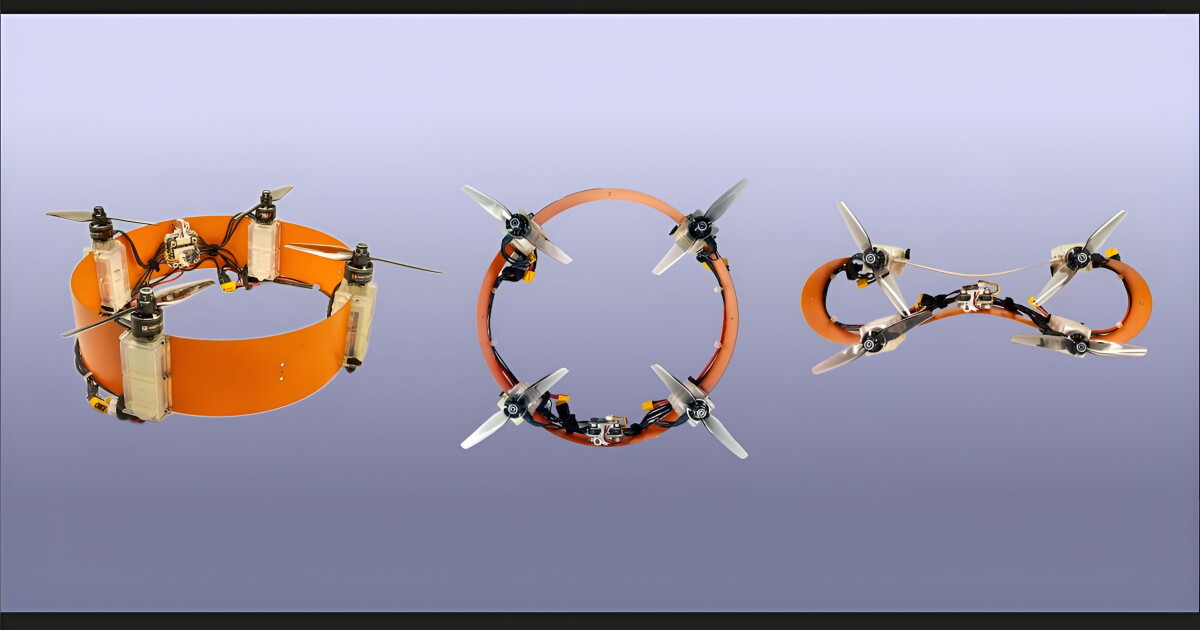
SummaryFlexiQuad from ETH Zurich moves beyond the rigid square frame, adopting a flexible ring structure that absorbs collision energy. The 405-gram prototype reaches speeds of 80 km/h in normal flight while surviving head-on collisions at speeds up to 25 km/h. This direction-dependent flexibility allows the vehicle to squeeze through tight spaces and grasp soft objects without a traditional gripping mechanism. |
Why it mattersMost drone safety systems rely on obstacle detection sensors, which can fail at high speeds or in crowded environments. FlexiQuad adds a passive, physical collision-survival layer that activates even when these systems fail. If the concept can be scaled beyond the 405-gram prototype, it could fundamentally transform drone use in tight indoor spaces, search-and-rescue, and inspection tasks where collisions are nearly inevitable. It also points to broader biomimetic design principles, such as direction-dependent stiffness inspired by bird and insect wings, which could influence other lightweight aerial or robotic platforms. |
Highlights- Direction-dependent stiffness: The ring is soft horizontally to absorb collisions but stiff vertically to maintain flight control. This feature is borrowed from bird and insect wings.
- It squeezed through an 180 mm gap (approximately 70% of the vehicle's width) and grasped a 136-gram soft first-aid kit by contracting its open frame.
- It survived intentional head-on collisions at speeds up to 25 km/h and continued flying, while maintaining a top speed of 80 km/h and accelerations above 3 g, similar to rigid square drones.
|
Critical takeThe demonstrated collision speed (18–25 km/h) is well below the drone's 80 km/h top speed, so high-speed collision survival remains unproven. The work is also merely an arXiv preprint rather than a peer-reviewed publication. The grasping demo used a soft first-aid kit, leaving serious questions open regarding the transport of hard or irregular loads and the scalability of the mechanism to larger, heavier airframes. |
This critique was written by the local AI model
Qwen3.8-27B. I chose the story; I do not review each critique before it is published.