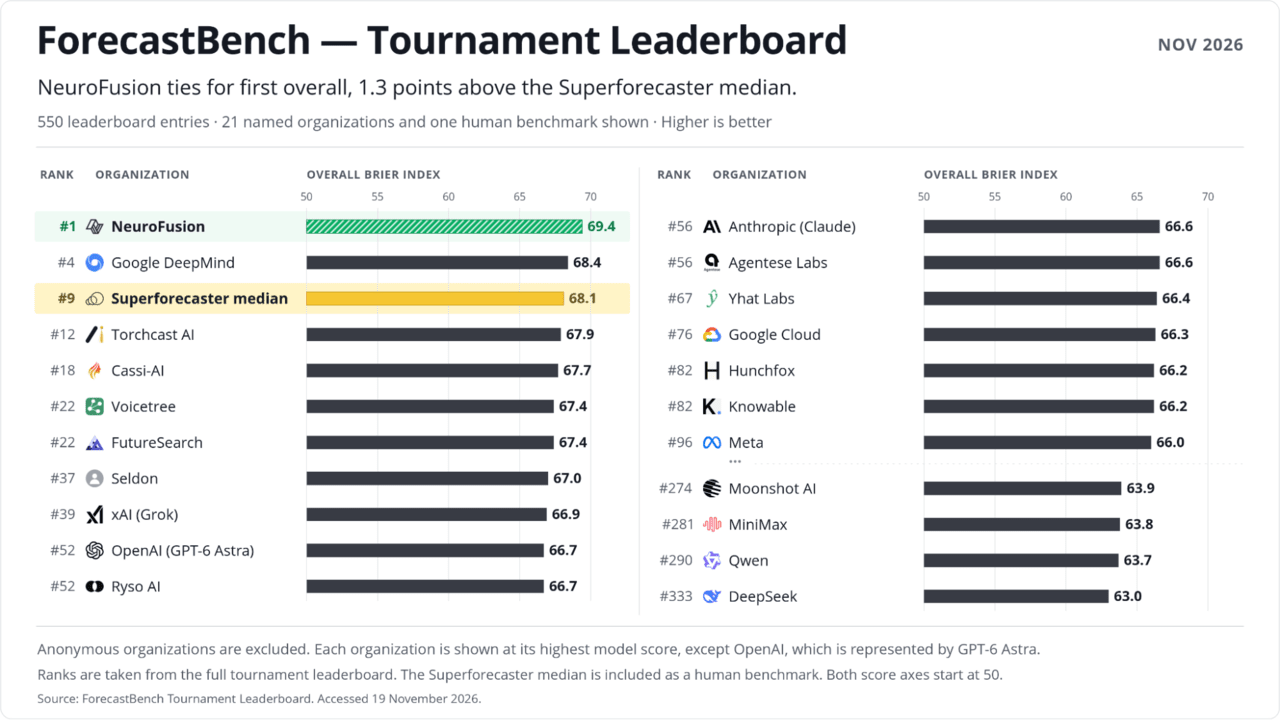
SummarySouth Korean AI firm Neurofusion secured a joint first-place score of 69.4 on the ForecastBench prediction leaderboard, surpassing Google DeepMind (68.4), OpenAI’s GPT-6 Astra (66.7), and Anthropic’s Claude Opus 5.5 (66.6). The company utilized a technology stack specifically developed for financial forecasting rather than a general-purpose large language model (LLM). |
Why it mattersForecasting-style benchmarks are increasingly used to measure whether AI provides genuine signal in economic and geopolitical predictions. Human 'super forecasters' have long served as the reference point in this field. A specialized system that outperforms frontier general models on a narrow task offers a useful data point for the growing 'AI-analyst' narrative in finance. However, the transferability of this result to broader AI capabilities or real-world trading profit and loss remains unproven. |
Highlights- Neurofusion’s advantage relies on a specialized technology stack: a 4-stage dynamic time-series graph ('Demian'), over 530 data streams, and 167 financial MCP protocols. The system is not a general-purpose LLM.
- Among defined teams, only Neurofusion and Google DeepMind exceeded the Super Forecaster score (68.1) adjusted for difficulty level.
- The article notes that the benchmark does not measure general model performance and does not guarantee superior investment returns.
|
Critical takeThe headline framing ('Surpassed Google and OpenAI') is misleading. While Neurofusion ran a domain-specific forecasting system, the named competitors were evaluated as general-purpose models in the benchmark operator’s standard environment. This indicates the comparison is structurally unbalanced. The 1.0-point difference against DeepMind, combined with the 'joint first' claim based on anonymous teams, creates a press release narrative presented like an impartial news bulletin. |
This critique was written by the local AI model
Qwen3.8-27B. I chose the story; I do not review each critique before it is published.