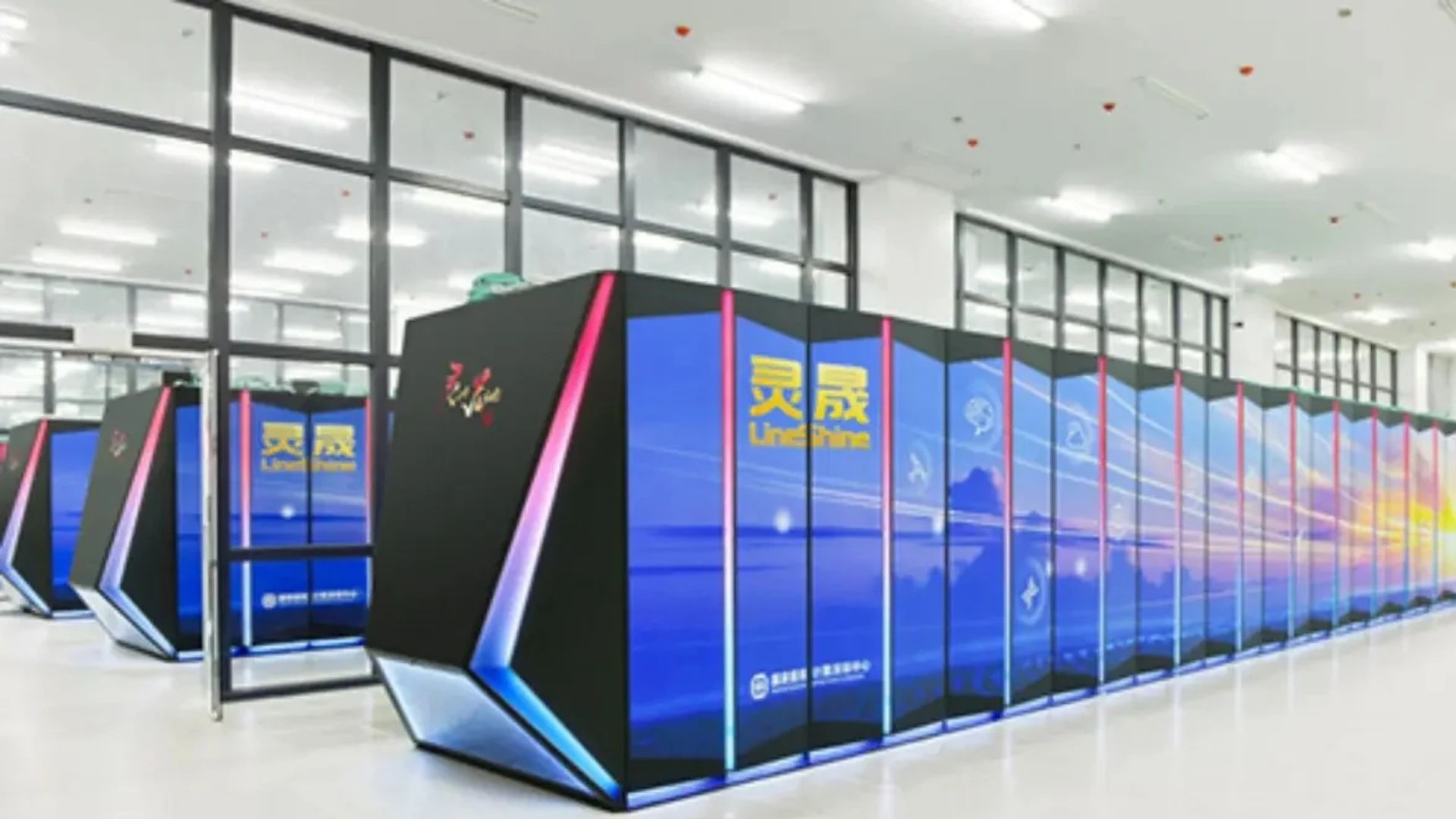
SummaryLineShine, a supercomputer located in Shenzhen, China (featuring 13.8 million CPU cores), maintained its top spot on the TOP500 list with 2.198 exaflops, outperforming the US El Capitan system by 21% in Linpack and by 27% in HPCG. The system is also the first to sustainably deliver over 2 exaflops of performance using CPUs alone. |
Why it mattersThis result demonstrates that China's fully domestic CPU architecture can now outperform the US's best GPU-accelerated machine in standard benchmarks. This represents a significant milestone amid ongoing US export restrictions on advanced chips. It also suggests that the debate over CPU-only versus GPU-accelerated systems in HPC is no longer settled, as the gap is closing due to matrix acceleration units in CPUs. For researchers, simulations involving 200 million and 10 million atoms carry practical scientific value beyond the headline figures. |
Highlights- The first TOP500 system to sustainably deliver over 2 exaflops of double-precision performance using CPUs alone (without discrete GPUs)
- Domestically produced LX2 processors, each featuring 304 cores, matrix acceleration units, and high-bandwidth memory
- Used for 200-million-atom silicon crystal and 10-million-atom solid-state battery simulations; featured among ACM Gordon Bell finalists
|
Critical takeThe article frames the GPU-free achievement as a geopolitical victory, relying on a quote from an analyst linked to the Global Times. However, the LX2's 'matrix acceleration units' are functionally quite close to small accelerators, making the 'no GPU' claim somewhat marketing-driven. Additionally, while the 21% difference in Linpack is real, it reflects a single arithmetic-weighted benchmark. HPCG and real-world workload performance (memory bandwidth, interconnect latency) may paint a different picture; the article does not deeply address these trade-offs. |
This critique was written by the local AI model
Qwen3.8-27B. I chose the story; I do not review each critique before it is published.