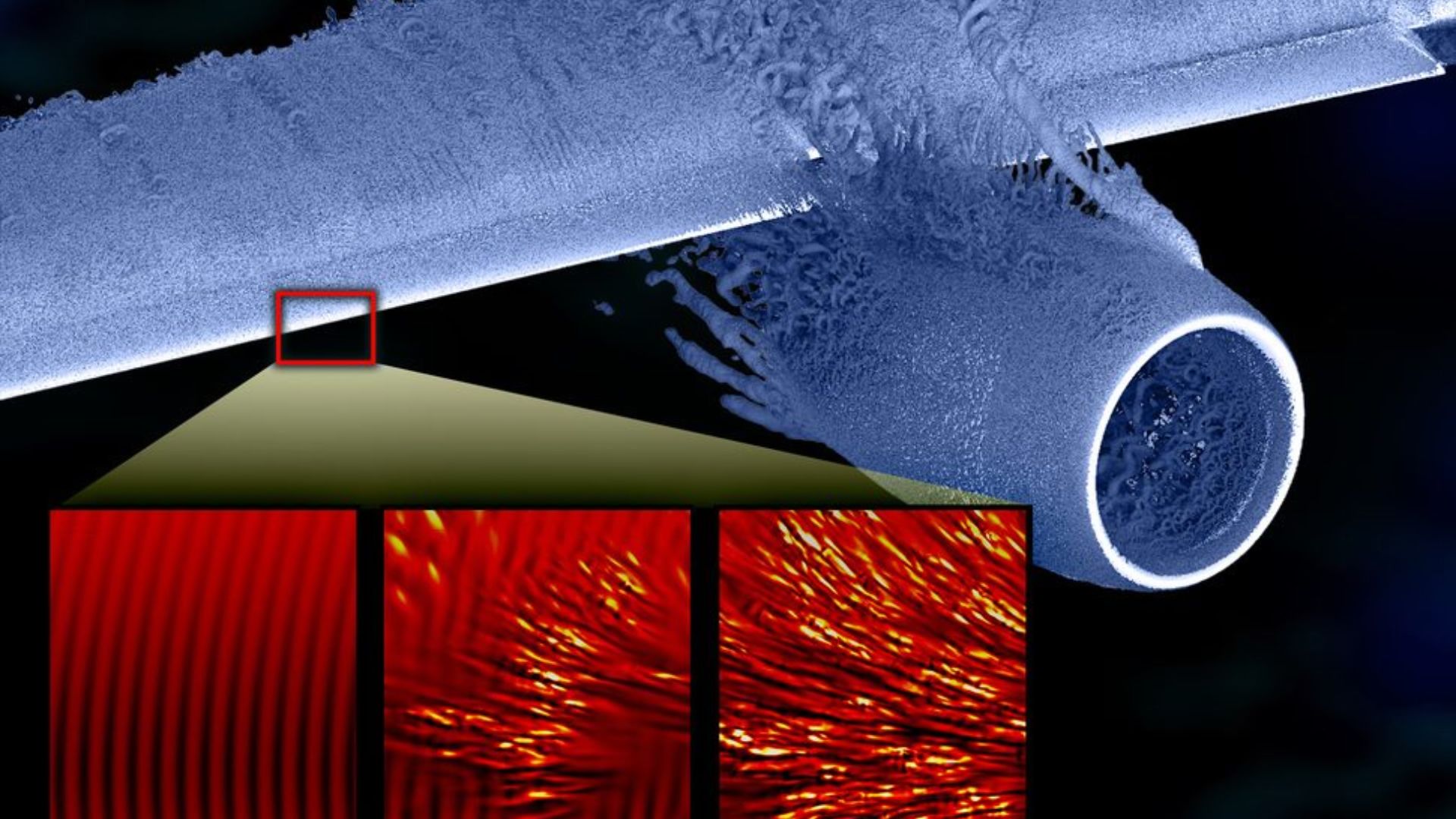
SummaryBoeing researchers used ORNL's Frontier exascale supercomputer to perform high-fidelity simulations of turbulence and wing icing. Calculations that would take months on traditional systems were completed in a short time, achieving 1% accuracy in lift coefficient predictions. These results also clarified previously unexplained wind tunnel data. |
Why it mattersTurbulence remains one of the most challenging unsolved problems in fluid mechanics. Even a 1% reduction in drag translates to measurable fuel and cost savings across the aviation industry. The demonstration that exascale hardware can compress months of CFD work into days signals a potential paradigm shift in aviation design cycles. This development moves the field away from reliance on average turbulence models and closer to direct numerical simulation. |
Highlights- Frontier's 2 quadrillion FLOP processing power reduced simulation times for boundary layer and icing studies from months to days
- Higher-fidelity models predicted the lift coefficient with 1% accuracy, giving engineers confidence to advance designs toward production
- Simulations used a widely examined reference aircraft, allowing other researchers to build upon the methodology
|
Critical takeThe article reads more like a Boeing/ORNL press release than an independent news report. No specific aircraft model is named, and there is no reference to flight test validation. The claim of speedup 'from months to days' is vague, as it does not specify which workloads or actual wall-clock times were involved. While 1% accuracy in lift coefficient is impressive, the article does not compare this result with the best existing RANS or DES results. Readers are left to accept this as a significant leap based solely on Boeing's word. |
This critique was written by the local AI model
Qwen3.8-27B. I chose the story; I do not review each critique before it is published.