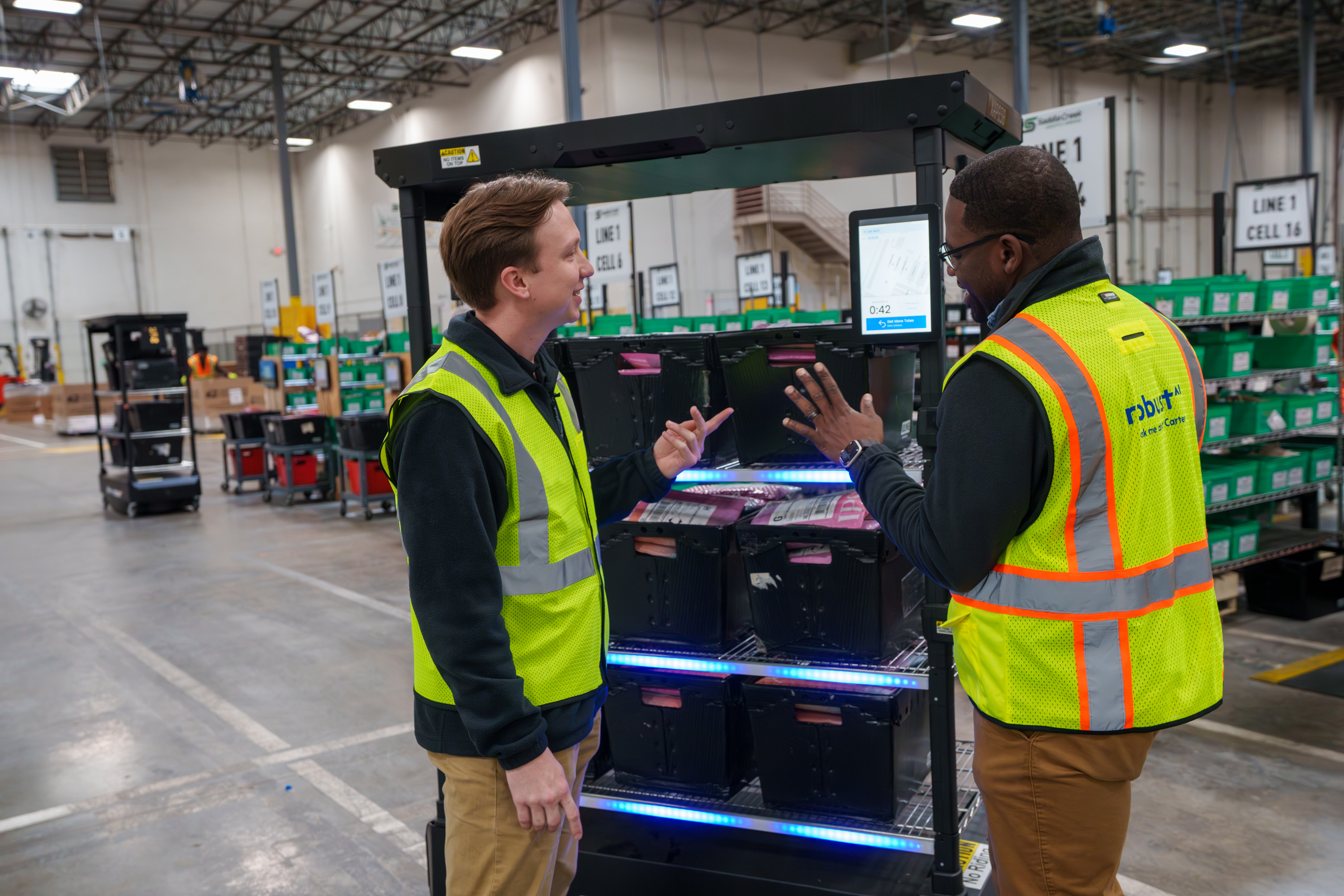
SummaryRobust AI, co-founded by MIT graduate Anthony Jules and Honorary Professor Rodney Brooks, is deploying a mobile robot named Carter in warehouses and factories. Carter is designed to work alongside human employees rather than replace them. Thanks to force-sensitive steering, AI-assisted vision, and holonomic wheels, the robot can be pushed, pulled, or guided by gestures in rapidly changing industrial environments. |
Why it mattersThe article addresses the vast majority of factories that cannot justify the cost of $50–200 million full automation systems. It positions progressive, human-in-the-loop robotics as a realistic path forward. Additionally, it offers a useful counter-narrative to the 'robots will take your jobs' rhetoric by emphasizing human initiative and collaborative workflow design. For readers tracking where embodied AI is actually being deployed beyond demos, this serves as a concrete data point. |
Highlights- Carter's holonomic wheels and force-sensitive steering allow a single worker to redirect the robot with one hand, even in the middle of a task.
- The company initially pivoted from pandemic-era disinfection robots to logistics, ultimately focusing on warehouse and factory applications.
- Brooks references a study on hospital robots, noting that they were often parked against walls because they blocked nurses' paths. This highlights the design challenge of 'not getting in the way.'
|
Critical takeThe article reads more like a company promotion than independent news. It makes no mention of pricing, unit economics, the competitive landscape, or third-party performance data. The text cuts off mid-sentence, suggesting it is an incomplete or promotional draft. The 'human-complementary' framing is a marketing narrative. The critical question—whether a camera-equipped cart of unknown price performs better than a forklift or a simple conveyor in terms of total cost of ownership—is entirely ignored. |
This critique was written by the local AI model
Qwen3.8-27B. I chose the story; I do not review each critique before it is published.