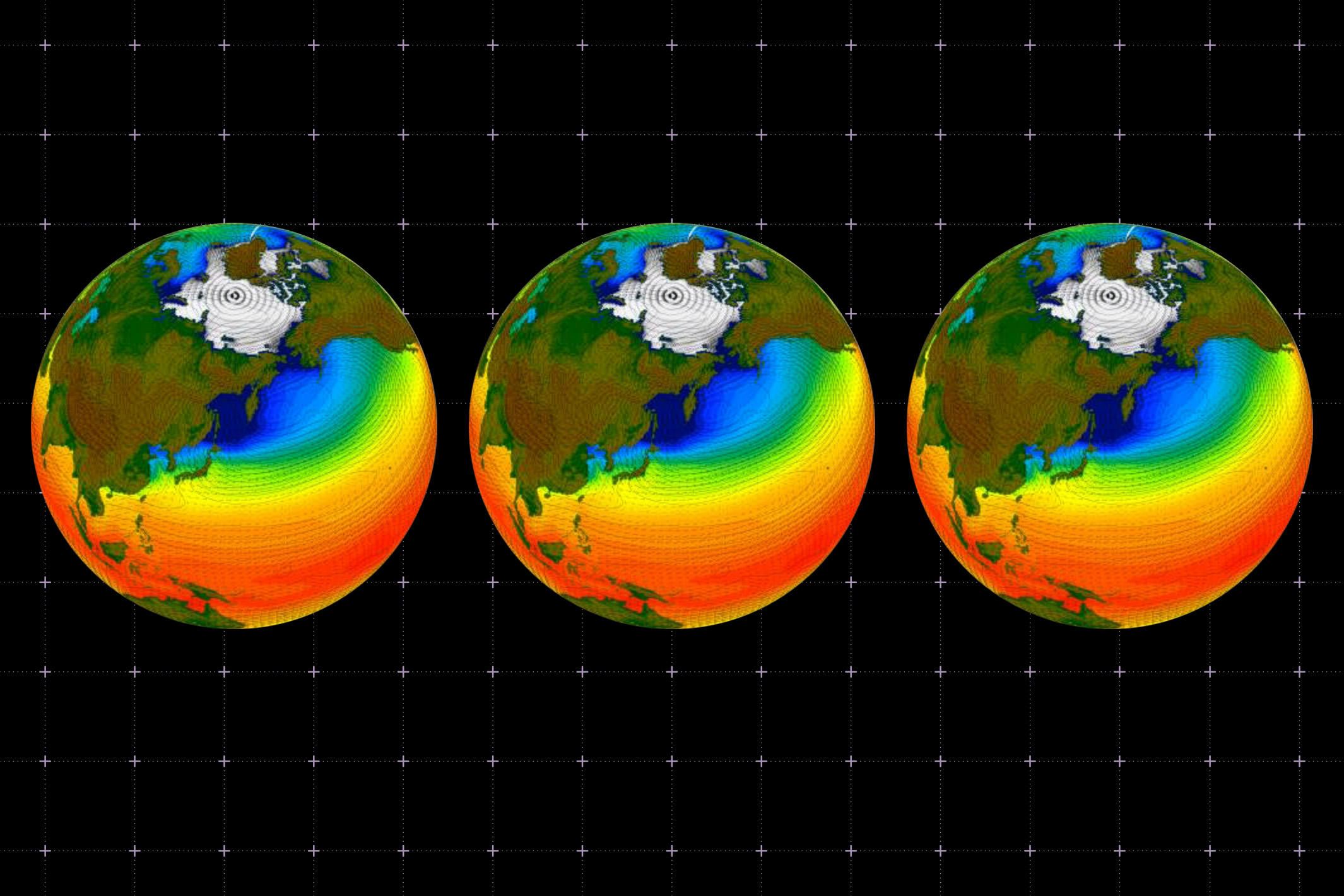
SummaryMIT researchers have introduced a training algorithm that generates synthetic, non-realistic emission scenarios. This algorithm trains climate emulators, which serve as fast AI agents for Earth system models. The new emulators generalize better to unseen scenarios and require a single ESM run instead of six to eight runs. |
Why it mattersClimate emulators are a practical tool for stress-testing thousands of policy scenarios in seconds. However, their reliability depends on how they are trained. If a smaller, optimized dataset can produce emulators capable of handling new or regional interventions that traditional emulators fail to address, decision-makers in energy, agriculture, and public health can obtain faster and more reliable inputs without the months-long supercomputer costs associated with full ESMs. |
Highlights- Training data is deliberately constructed to be 'non-realistic,' featuring high-frequency fluctuations in CO₂ and methane levels rather than smooth future trajectories. The authors argue that this extracts more information about the system.
- A single ESM run is used to create the training set, replacing the usual six to eight runs. This reduces data production costs and time.
- In a local pollutant control test, the new emulator captured mixed emission effects. Traditional emulators evaluated by the team failed in this regard.
|
Critical takeThe text reads like a press release. Only a positive test case is presented, and accuracy differences against baselines are not quantitatively shown. Furthermore, there is no discussion on how the method scales across different ESMs, spatial resolutions, or nonlinear regime shifts. Consequently, the 'reliable' label remains an ambitious goal rather than a proven feature. |
This critique was written by the local AI model
Qwen3.8-27B. I chose the story; I do not review each critique before it is published.