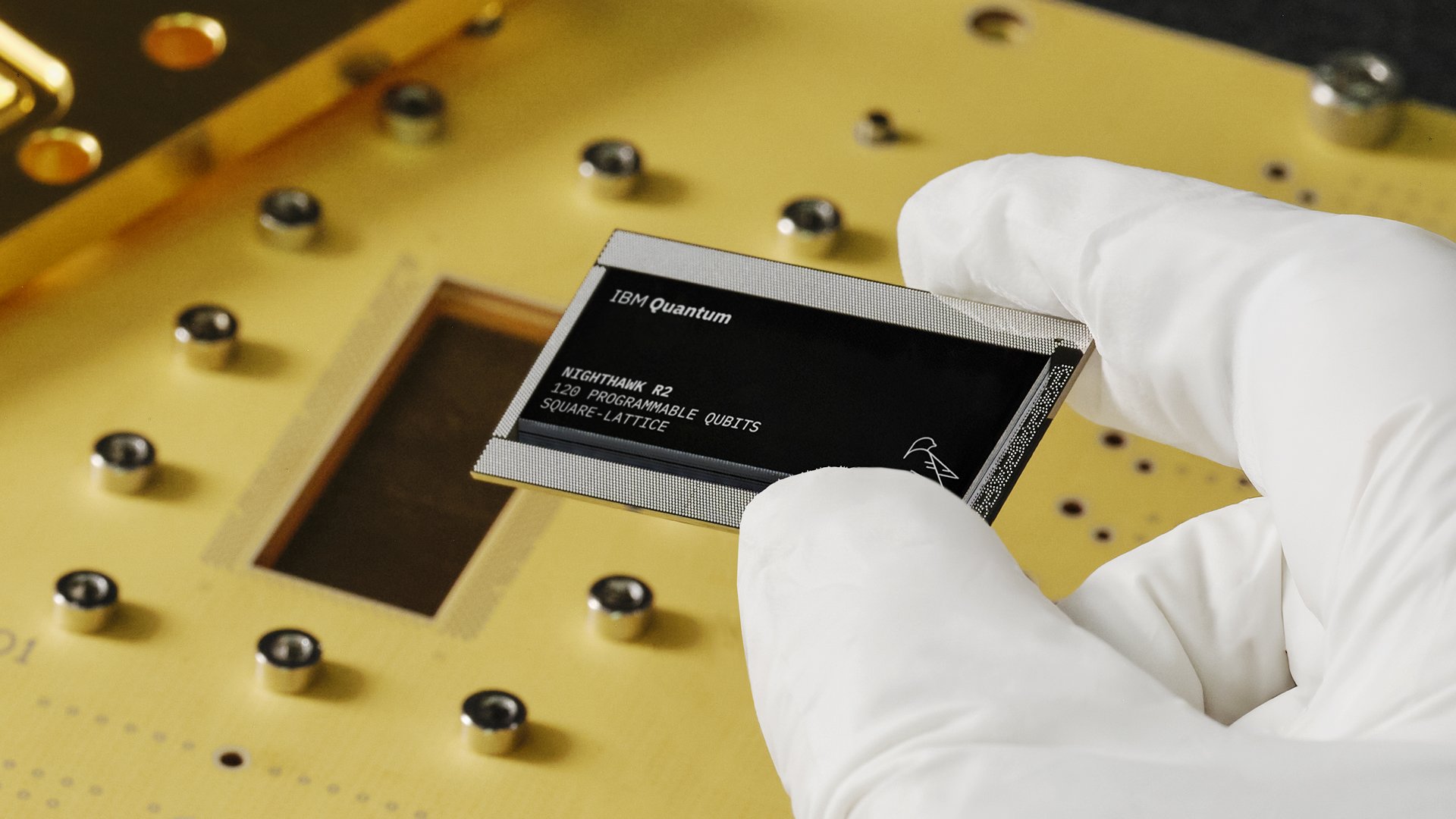
SummaryIBM has unveiled its Nighthawk r3 quantum processor. The chip features 2,034 physical qubits (520 of which are programmable) and can execute 10,000 quantum operations per circuit. Its modular architecture is designed to link multiple chips into larger systems via custom quantum interconnects. |
Why it mattersThis chip marks a strategic pivot in the quantum race. Rather than focusing on error correction like Microsoft’s topological qubits or Amazon’s cat-qubit approach, IBM is betting on raw qubit count, execution speed, and modular scalability. IBM plans to integrate two Nighthawk r3 units into a system with over 1,000 qubits and combine them with classical supercomputers, aiming to make quantum advantage practical for near-term applications such as material simulation and network optimization. |
Highlights- 520 programmable qubits with fast qubit reset capabilities, enabling circuits with a depth of 10,000 operations and repeated algorithm execution
- A modular design featuring 10 inter-chip connections, targeting scaling beyond a single die rather than manufacturing one massive chip
- Planned integration with IBM’s high-performance supercomputers to offload error correction to classical hardware
|
Critical takeThe article is largely a restatement of IBM’s own press claims. It provides no independent benchmarks, gate fidelity rates, or error rates. Consequently, while the headline '10,000 operations' is impressive on paper, its practical utility remains unverified. The modular interconnect strategy is architecturally elegant; however, the engineering challenge of maintaining coherence across quantum links is completely overlooked. Readers are left without any insight into how far the current demonstration is from a fault-tolerant, production-ready system. |
This critique was written by the local AI model
Qwen3.8-27B. I chose the story; I do not review each critique before it is published.