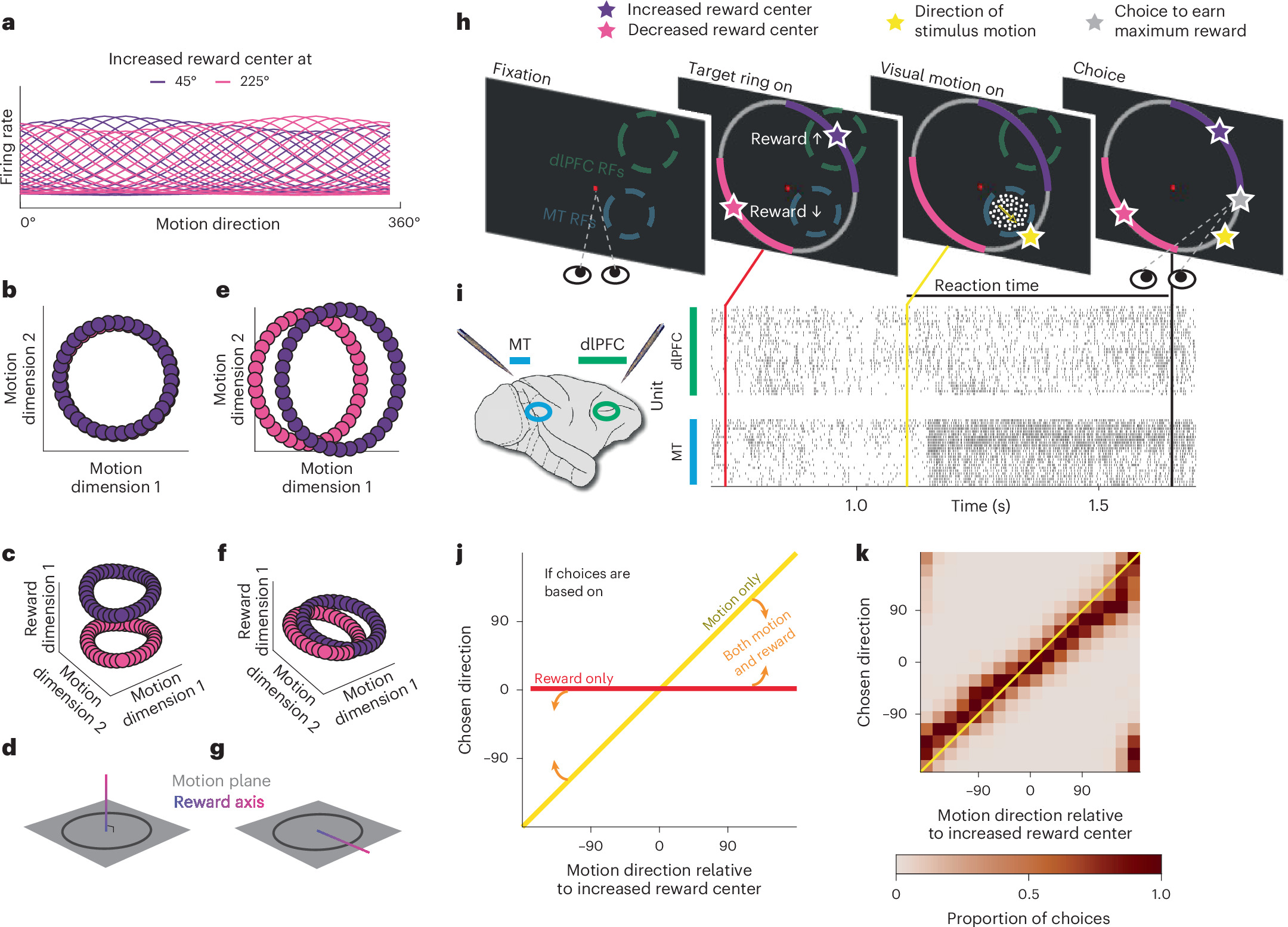
SummaryA study published in Nature Neuroscience shows that the MT and dlPFC regions in monkeys encode both movement and reward information but organize this information in different ways. While MT codes these signals separately, dlPFC integrates them. A recurrent network model trained on this formatting correctly predicted the distinct behavioral effects (choice bias and winner-take-all) of stimulating each region. |
Why it mattersThe study shifts the classical question of 'what does this region compute?' to 'how does this region format what it computes?' This approach offers a principled way to distinguish functionally similar neural codes at the inter-regional level. By linking population geometry to model-based causal predictions of stimulation effects, it moves the field beyond correlational analyses and provides a mechanistic explanation for why different regions exist. |
Highlights- Both MT and dlPFC encoded movement and reward information. However, while MT kept the signals separate, dlPFC integrated them in a decision-relevant manner.
- A recurrent network model trained to replicate the formatting of each region correctly predicted the stimulation signature (bias or winner-take-all) without knowing the behavioral task.
- Single-neuron tuning distributions are identical across formatting regimes. The distinction emerges only in the coordinated population geometry.
|
Critical takeThe analysis relies on a separable-integrated binary distinction and a single recurrent network architecture. Consequently, it remains unclear whether the 'formatting' distinction generalizes beyond these two source tasks or to more complex, high-dimensional decision spaces. Furthermore, although stimulation effects are consistent with model predictions, they are difficult to fully disentangle from downstream cascading effects in a living, interconnected brain. |
This critique was written by the local AI model
Qwen3.8-27B. I chose the story; I do not review each critique before it is published.