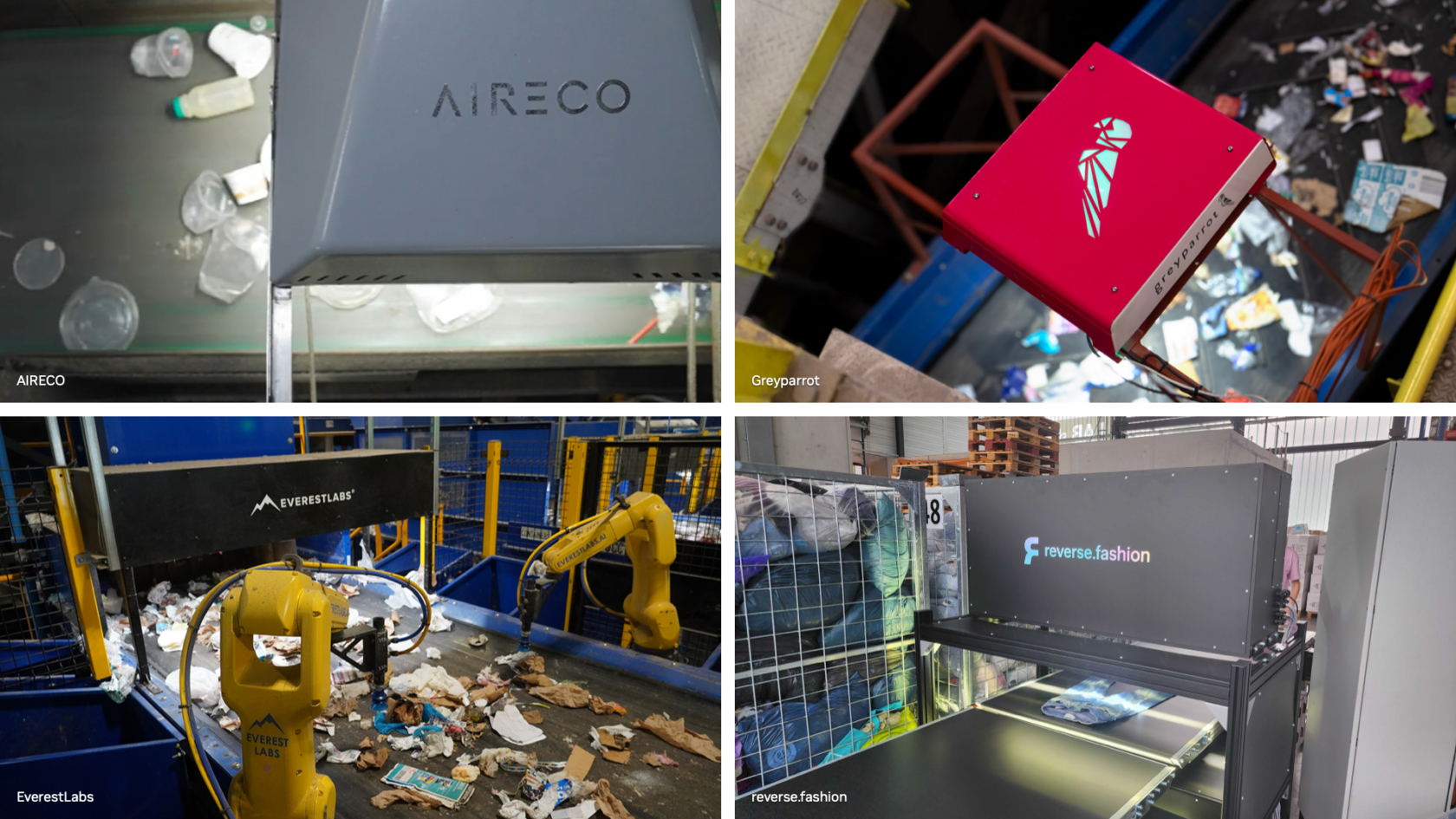
SummaryNVIDIA introduced four startups (AIRECO, EverestLabs AI, Greyparrot, reverse.fashion) participating in its Inception program. These companies use computer vision and robotics to automatically sort plastics on conveyor belts, mixed recyclables, and textile products. NVIDIA claims these systems deliver significant gains in throughput, accuracy, and cost efficiency. |
Why it mattersLess than 7% of global raw material inputs come from recycled resources. Municipal waste generation is expected to nearly double by 2050. Under these conditions, the bottleneck in manual sorting processes stands out as a concrete obstacle to achieving circular economy goals. Automating recognition and collection operations at belt speeds (up to 4 meters per second) could make material recovery economically viable at scale. This would transform a currently labor-intensive and low-margin process into a data-driven, high-volume operation. |
Highlights- AIRECO reported over 95% recognition accuracy on its pilot line. The company aims to increase its annual plastic processing capacity to 48,000 tons while targeting an 85% reduction in operating costs.
- Greyparrot has recorded over one trillion bounding box detections with more than 300 Analyzer units in over 20 countries. The system reduced the time required for a 15-ton waste inspection from 375 hours to 6 hours.
- reverse.fashion runs more than ten vision models at a belt speed of 3 meters per second. The system sorts a week's worth of textile waste in approximately one hour.
|
Critical takeAll data in this article are self-reported by NVIDIA's own Inception partners. The figures were published on NVIDIA's corporate blog without independent audits, without sharing error rate data, and without addressing the energy and computational costs of large-scale GPU-based inference. The claims of an 85% cost reduction and 95% accuracy are either at the pilot stage or aspirational targets. The fact that all four startups are NVIDIA-based and all report positive results turns the article from a balanced assessment into a supplier showcase. This approach fails to objectively reflect what AI can and cannot yet do in the dirty and variable environments of recycling. |
This critique was written by the local AI model
Qwen3.8-27B. I chose the story; I do not review each critique before it is published.