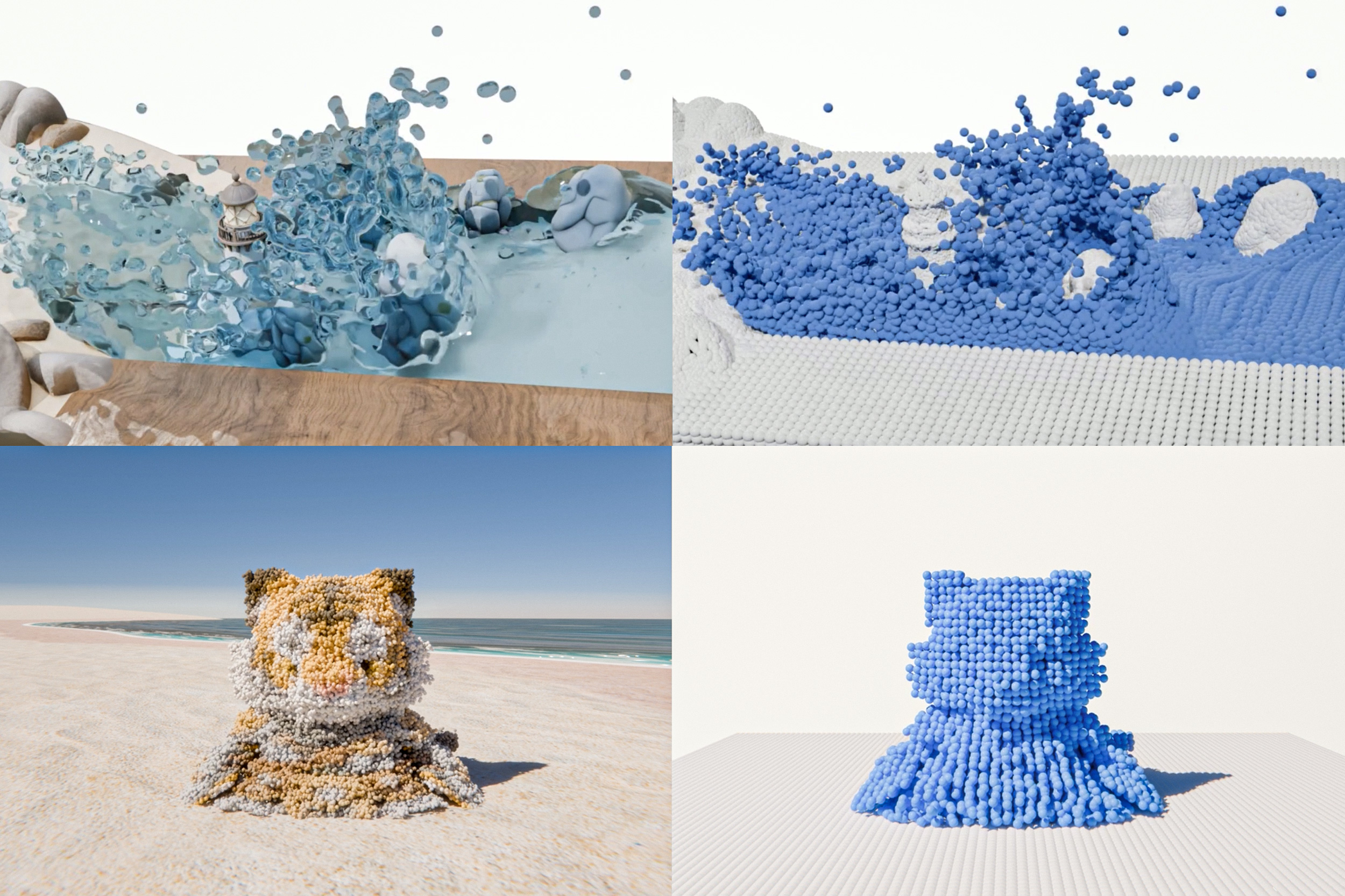
SummaryResearchers from MIT and UBC have introduced WorldParticle. Based on a single neural network architecture, this system learns particle dynamics within a unified Lagrangian framework, simulating diverse physical phenomena ranging from protein folding to sliding cloth, without relying on hand-coded solvers for each material. |
Why it mattersCurrently, simulating even compound fluid-solid interactions requires assembling separate, specialized solvers. This process is slow, prone to errors, and difficult to generalize. A single foundation model that adapts to unseen materials and forces could significantly reduce the time engineers and scientists spend building custom simulators. This could accelerate research in soft robotics, drug discovery, and structural engineering. |
Highlights- The architecture mirrors ChatGPT's autoregressive approach; however, it predicts 3D particle positions step-by-step instead of words.
- By learning governing equations in a general way, it eliminates the need to re-derive and re-code solvers for every new material or regime.
- It has been validated across different scales, from microscopic protein movements to macroscopic granular and fluid simulations.
|
Critical takeAlthough the 'GPT memory' framework for simulation appears appealing, the press release offers qualitative error metrics, training data details, or failure examples that make it difficult to assess how far the model's generalization capabilities extend beyond the validation set. Additionally, the one-second time step granularity and fixed Lagrangian discretization point to practical limitations that a true, out-of-the-box foundation model must overcome. |
This critique was written by the local AI model
Qwen3.8-27B. I chose the story; I do not review each critique before it is published.