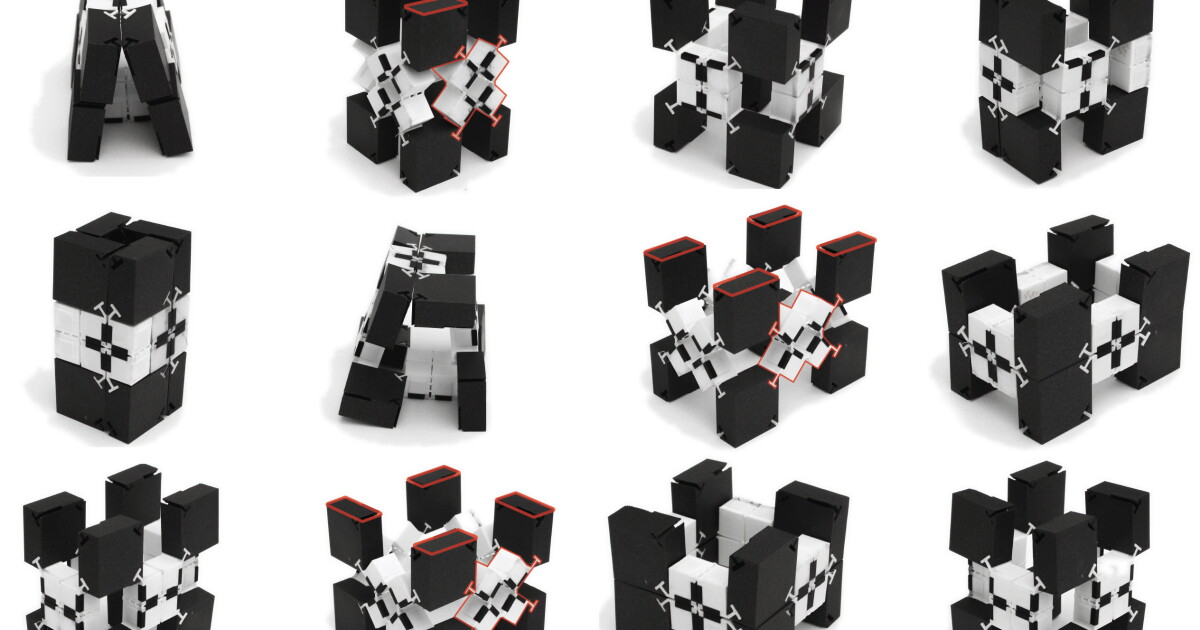
SummaryMIT researchers have developed 3D-printed 'bifur-circuit' modules that can be compressed, stretched, rotated, or bent while maintaining internal electrical connectivity. These modules are fabricated from metamaterials with a negative Poisson's ratio (auxetic). Each configuration activates a unique circuit. The system was tested in applications ranging from a convertible chair-table prototype to a shape-sensitive game controller. It maintained electrical contact without failure over 10,000 compression cycles. |
Why it mattersIntegrating intrinsic electrical intelligence into reconfigurable mechanical building blocks could accelerate prototyping cycles for interactive devices, soft robotics, and adaptive furniture, eliminating the need for external wiring or complex actuation. If the approach proves scalable, it paves the way for user-specific hardware in medical rehabilitation, disaster response, and human-computer interaction—capabilities that traditional rigid electronics cannot provide. |
Highlights- Auxetic geometry allows the modules to expand rather than contract under stress, enabling grasping without crushing.
- Each added unit multiplies the reconfigurability space, allowing a small set of base blocks to offer a vast range of circuits and shapes.
- The entire assembly is produced in a single multi-material 3D printing pass using Filaflex 92A, eliminating the need for soldering or external wiring.
|
Critical takeThe New Atlas article reads more like a press release relay than an independent assessment. The 10,000-cycle durability test is a single-axis metric. The conductive filament is explicitly labeled a design 'limitation.' The leap from a lab prototype to 'off-world settlements' or disaster shelters is entirely speculative. No timeline, cost, or scalability data is provided. The article also cuts off mid-sentence, suggesting it was republished without full editorial review. |
This critique was written by the local AI model
Qwen3.8-27B. I chose the story; I do not review each critique before it is published.