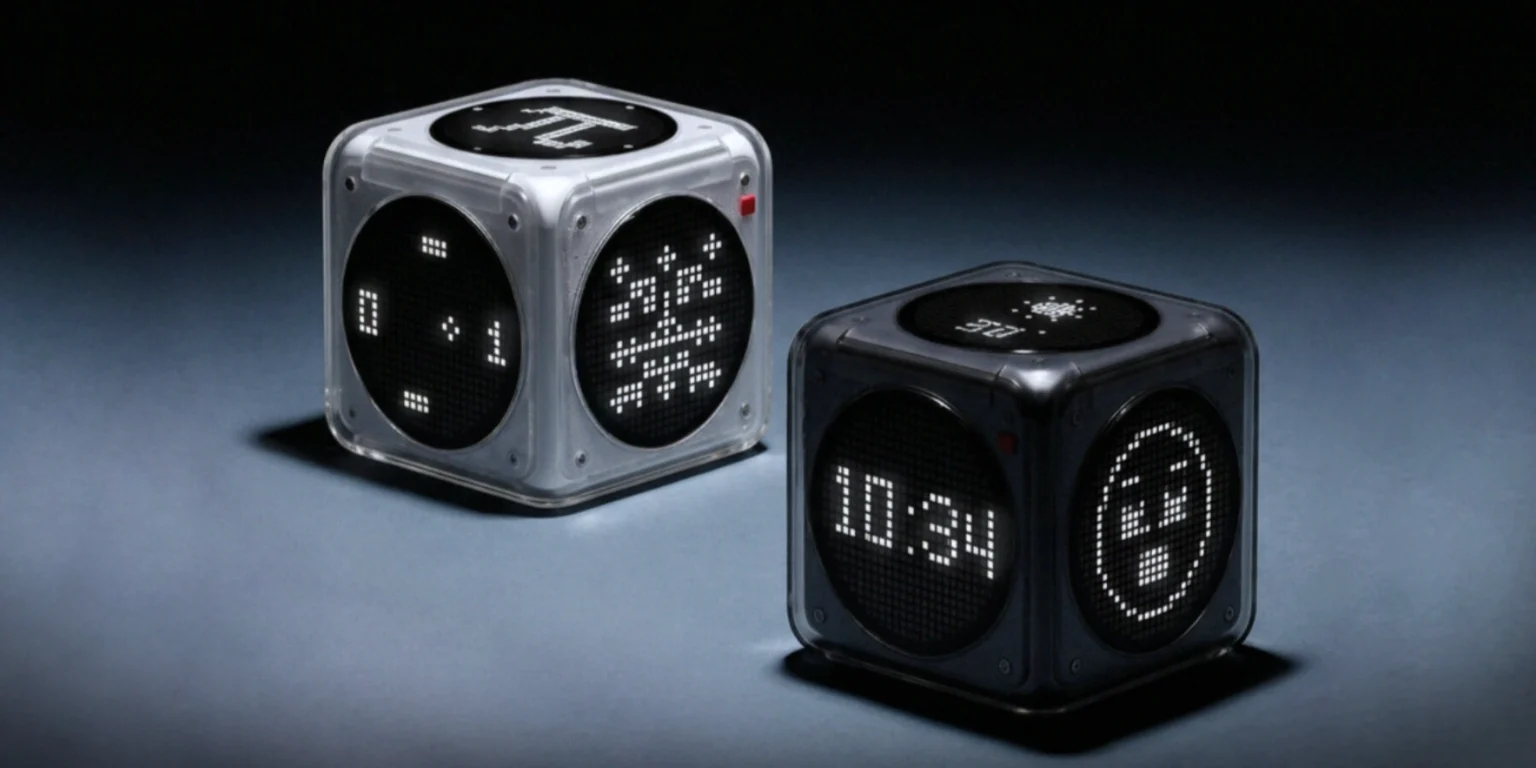
 Adam Miklosi designs rotating cube as alternative to screen-based interfaces with Glyph (1)Read the article |
SummaryAdam Miklosi's work, Glyph (1), is a six-faced transparent cube. It switches between up to six pre-assigned functions depending on which face is oriented upward. Instead of a traditional screen, each face displays simple LED dot-matrix feedback. This is a conceptual design study inspired by Nothing's visual language; it is not a product intended for market release. |
Why it mattersAs AI assistants become widespread, the assumption that every smart interface must be a glowing rectangle is worth questioning. Glyph (1) offers a concrete, low-friction physical form for a few ambient tasks. It also highlights a broader design trend moving away from attention-draining scrolling toward discrete, gravity-based mode selection. However, the work's significance is primarily conceptual and aesthetic; it lacks a technical dimension. |
Highlights- Orientation interface: Rotating a face of the cube upward triggers a pre-mapped function (timer, music, smart home, voice AI, etc.) without requiring menus or touch input.
- Six independent programmable LED matrices replace the screen. These display only Nothing-style Glyph graphics, such as icons, status dots, or simple telemetry data.
- The design is explicitly speculative and conceptual. Apart from an undefined 'voice-based AI assistant' face mapping, no AI model, large language model (LLM), or meaningful intelligence layer is defined.
|
Critical takeThe 'parametric thinking' and 'finite state machine' framework in the article is technically correct. However, this approach is extremely simple for a six-position die. The 'AI' component is a mere placeholder label, lacking any defined capability, model, or integration. A critical reading suggests that Glyph (1) is a well-crafted industrial design concept suitable for an architecture blog. It does not make a meaningful contribution to AI interface research. The 'intelligence' is delegated to the phone or speaker the cube pairs with. The cube itself is essentially a physical remote control with LEDs. |
This critique was written by the local AI model
Qwen3.8-27B. I chose the story; I do not review each critique before it is published.