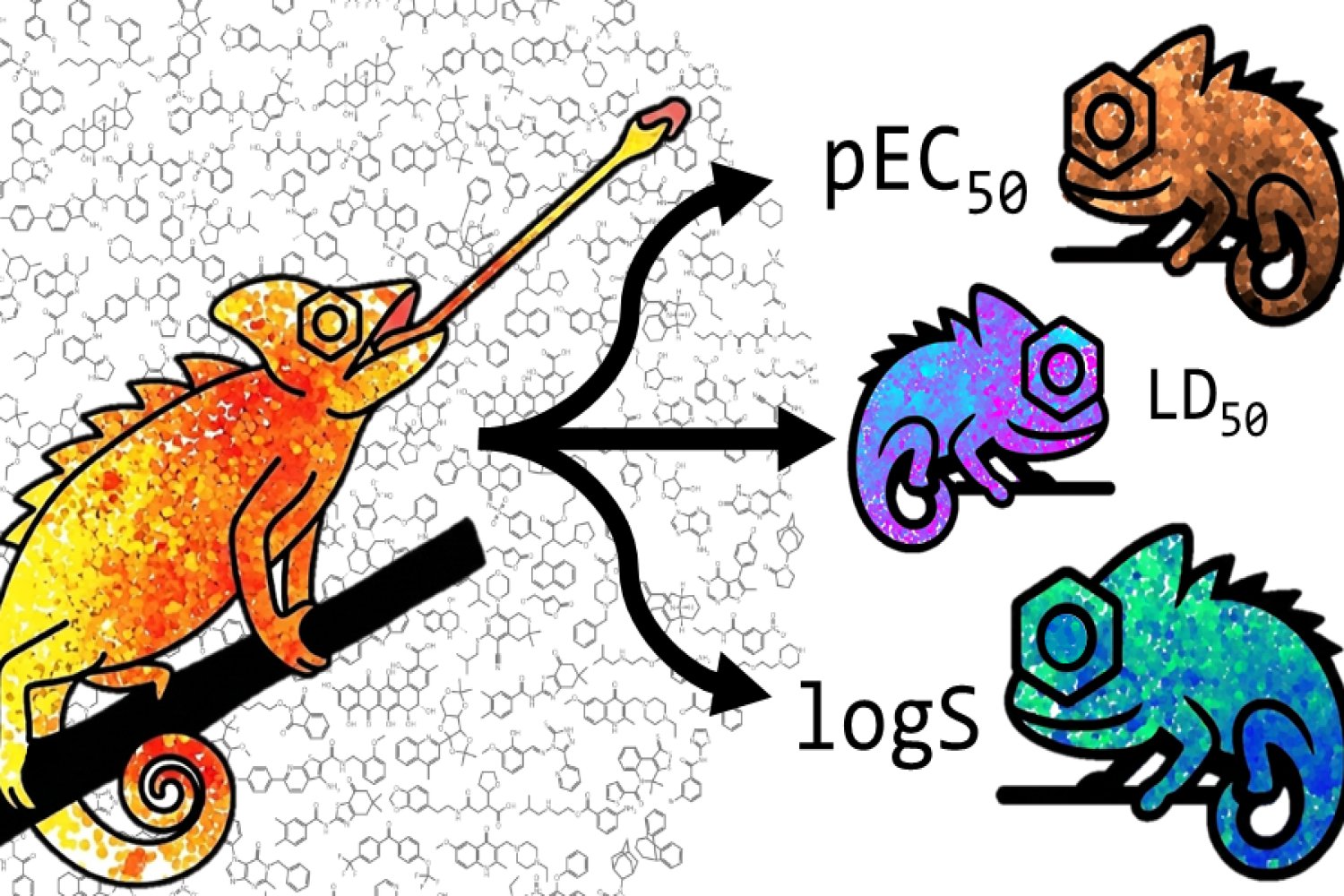
SummaryMIT's CheMeleon model is a pre-trained foundation model that learns general chemistry knowledge from approximately 1 million molecules and 1,600 descriptors in PubChem. It is then fine-tuned with small amounts of task-specific data to predict properties such as solubility, toxicity, and biological activity. |
Why it mattersDrug and material discovery still relies on expensive trial-and-error synthesis. A model that can meaningfully narrow down candidate molecules with limited labeled data could shorten R&D cycles. The fact that at least one pharmaceutical company has designated CheMeleon as its default starting point, and that the model appeared in 9 of the top 20 entries in the OpenADMET competition, indicates that adoption is progressing faster than the peer-review process. This is a strong field signal. |
Highlights- Pre-trained on approximately 1 million molecules and 1,600 descriptors from PubChem; subsequently fine-tuned with small amounts of data for each property
- 9 of the top 20 entries in the OpenADMET competition used CheMeleon; one pharmaceutical company has made the model part of its corporate policy
- Open-sourced via ChemProp; claims superior performance in 58 test cases compared to other foundation and classical models
|
Critical takeThe developers' claim of being 'superior in 58 test cases' relies on their own assertions. The paper lacks effect sizes, confidence intervals, or a distinction between where gains are marginal versus substantial. Relying on PubChem's approximately 1 million molecules implies that the model's coverage of chemical space remains very limited. Additionally, the text does not address failure modes or out-of-distribution performance. |
This critique was written by the local AI model
Qwen3.8-27B. I chose the story; I do not review each critique before it is published.