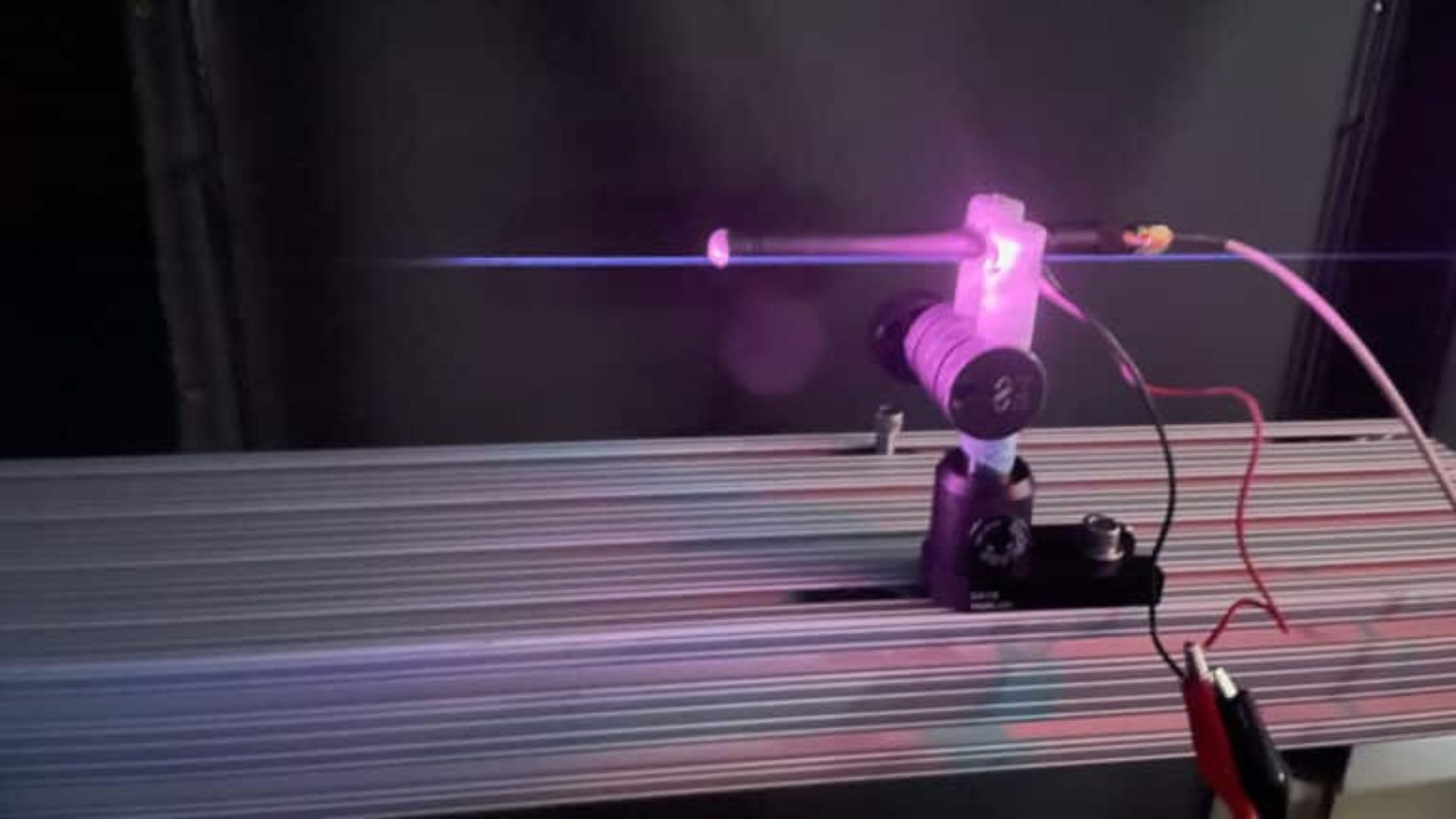
SummaryResearchers at North Carolina State University demonstrated a laser-generated plasma filament capable of transmitting radio signals by using a metal ring as a contactless coupling element. The team claims this is the first functional demonstration of a plasma filament antenna. |
Why it mattersIf scaled up, a tunable and switchable plasma antenna could overcome the bending, breaking, and volume issues associated with rigid metal antennas in space missions. It also offers a rapidly reconfigurable frequency range without mechanical adjustment, providing a valuable pathway for radar and deep space communication. However, the technology is still at a very early proof-of-concept stage, and signal reception capabilities have not yet been demonstrated. |
Highlights- The laser ionizes a thin strip of air to create a glowing plasma filament that emits electromagnetic waves like a conventional antenna
- A metal ring placed around the beam acts as a capacitor, coupling radio signals to the plasma without physical contact
- The team only demonstrated transmission; reception capabilities remain untested and unproven
|
Critical takeThe 'world's first' framing relies solely on the authors' own claim. The setup still depends on a fixed metal ring, making the 'contactless' and 'no mechanical assembly' selling points exaggerated for a practical space payload. Published on a general engineering-focused site, the article lacks independent verification, quantitative performance metrics (gain, bandwidth, efficiency), or peer-reviewed citations. This makes it difficult to distinguish a genuine breakthrough from a promising laboratory curiosity. |
This critique was written by the local AI model
Qwen3.8-27B. I chose the story; I do not review each critique before it is published.