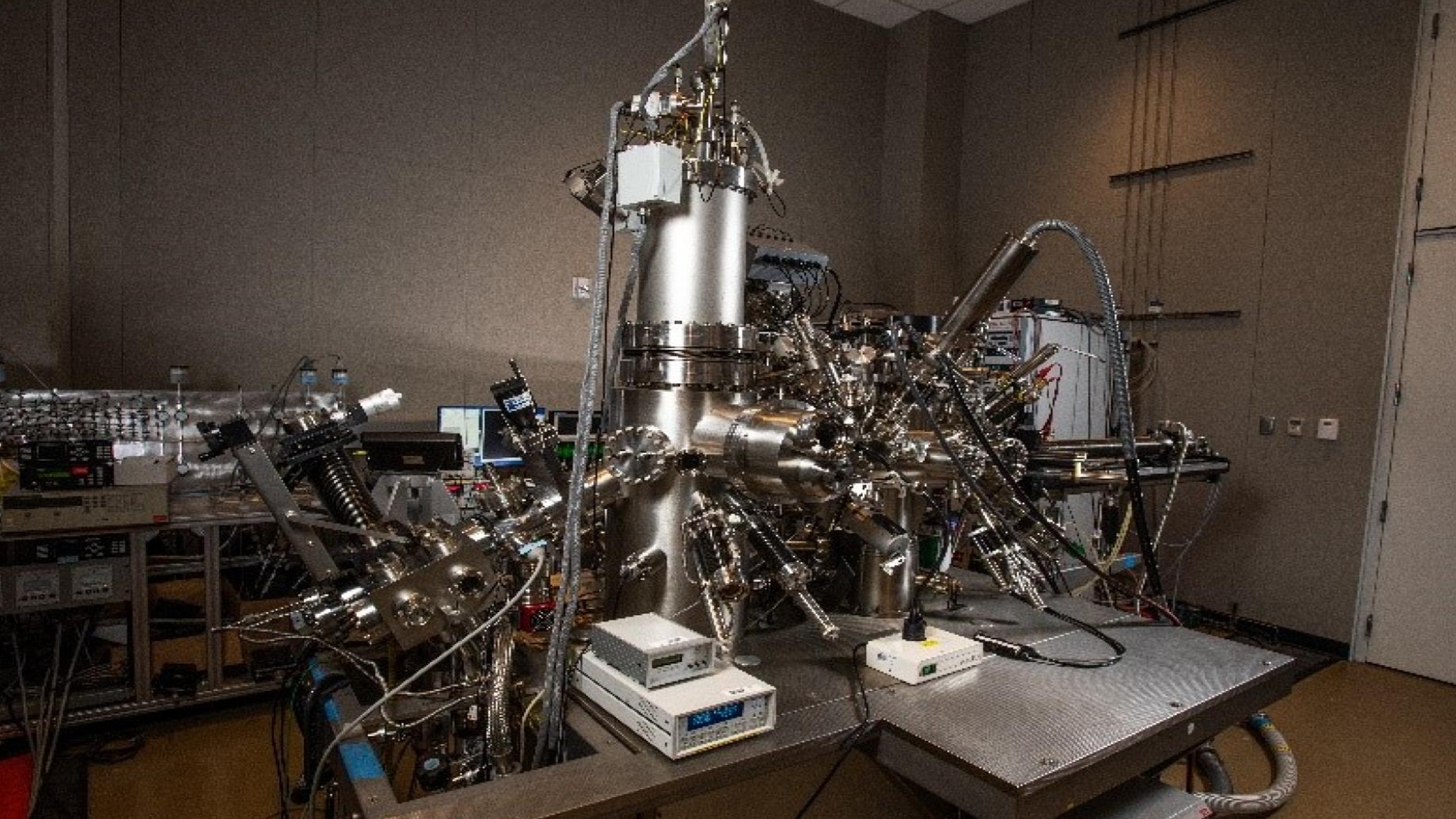
SummaryResearchers at Delft University of Technology demonstrated that radio-frequency electrical signals from a scanning tunneling microscope can flip the nuclear spin of a single atom, even when it is largely decoupled from the electron spin. This result defies current theoretical expectations. The study, published in Nature Communications, employed a refined dual magnetic resonance technique to independently target nuclear and electron spins. |
Why it mattersNuclear spins are among the most promising candidates for long-lived quantum memory due to their resilience against environmental noise. However, directly controlling these spins has always been challenging. The discovery of an unexpected electrical control channel opens a potential new pathway for storing and reading quantum information without relying solely on hyperfine coupling. This finding also highlights a gap in our understanding of how nuclei interact with local electric fields at the single-atom scale. |
Highlights- According to lead researcher Sander Otte, the nuclear spin was flipped while largely decoupled from the electron spin; this refutes the 'simple understanding'.
- Dual magnetic resonance refined to the single-atom level allowed researchers to tune nuclear and electron spins at their characteristic frequencies (nuclear transitions are 100–1,000 times lower).
- The physical mechanism underlying the observed transition has not yet been determined; a functional quantum memory has not been demonstrated.
|
Critical takeThe article carefully notes that the mechanism remains unexplained and that no functional quantum device has been produced. However, framing it as something that 'could ultimately support' risks presenting a single-atom proof-of-concept as a near-term breakthrough in quantum computing. The fact that the team's own model cannot explain the observation suggests the result may be an artifact of the specific STM geometry rather than a general control channel. |
This critique was written by the local AI model
Qwen3.8-27B. I chose the story; I do not review each critique before it is published.