 Human hippocampus uses similar semantic coding as large language modelsRead the article English (automatic translation) |
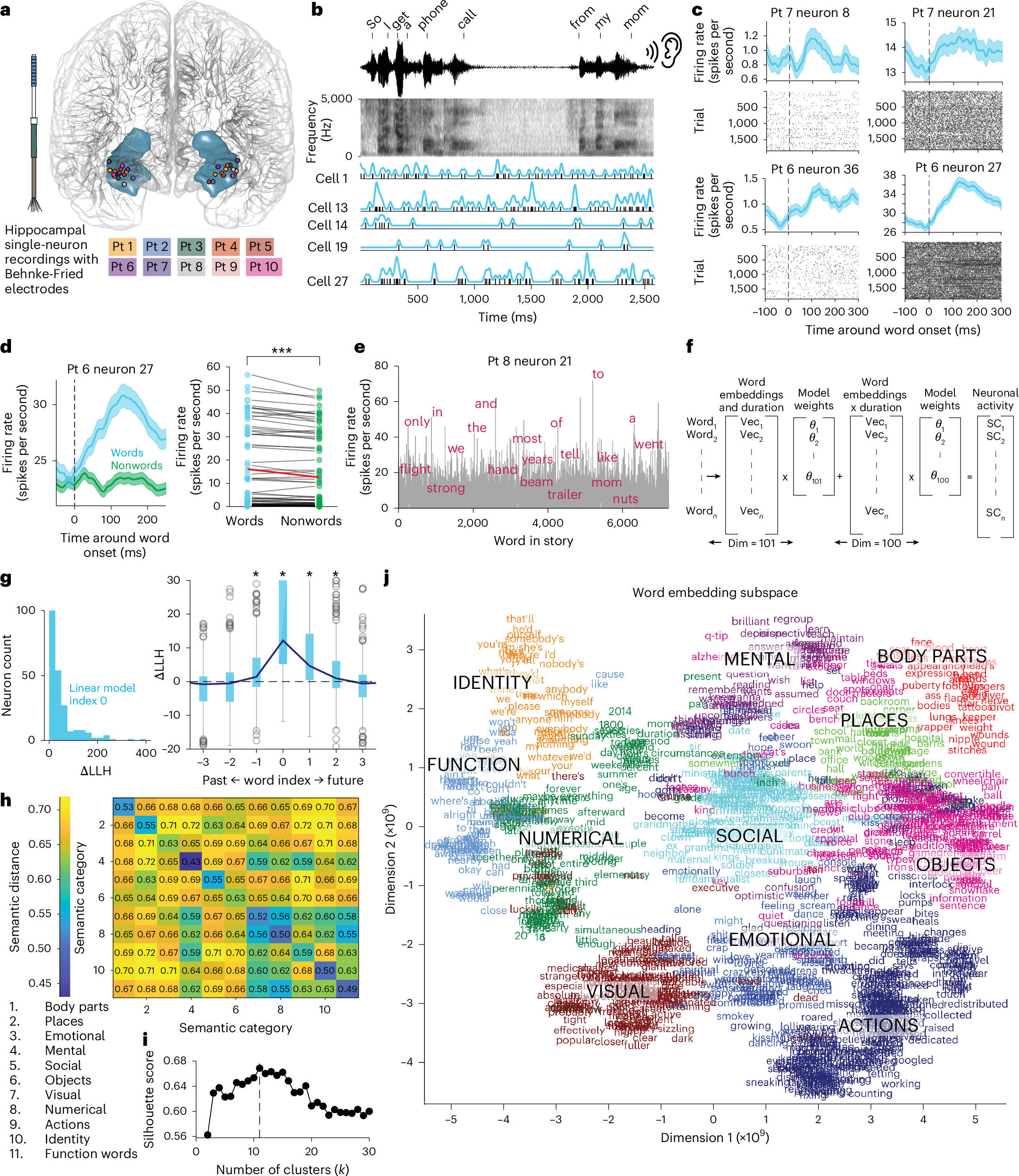
SummaryResearchers recorded hippocampal neurons during narrative speech. They found that activity in the neuronal population encodes word meanings in a distributed and context-sensitive manner. The geometric structure of this activity, specifically the distance relationships, largely overlaps with the embedding spaces of large language models (LLMs). The strongest alignment is achieved with GPT-2 vectors. |
Why it mattersThis finding represents one of the most direct empirical bridges drawn between the coding scheme of a specific brain region and the representational geometry of transformer-based language models. It adds biological plausibility to the idea that LLMs capture something real about how humans process meaning. It repositions the hippocampus not merely as a memory store, but as an active semantic encoder during real-time language comprehension. This has significant implications for both cognitive theory and the interpretability of LLMs. |
Highlights
|
Critical takeWhile the alignment achieved with GPT-2 is striking, it carries a caveat. GPT-2 is a 2019 model with 1.5 billion parameters. The 'closest match' expression may stem from the simplicity of the task, i.e., passive listening to narratives. This does not necessarily imply a deep computational isomorphism with the latest generation of LLMs. The observed inverse correlation for similar words is explained in a single sentence as the 'noise-reduction benefit of contrastive coding.' This explanation lacks a formal model or control to rule out simpler confounding factors, such as response saturation or recording noise in the hippocampal population. |