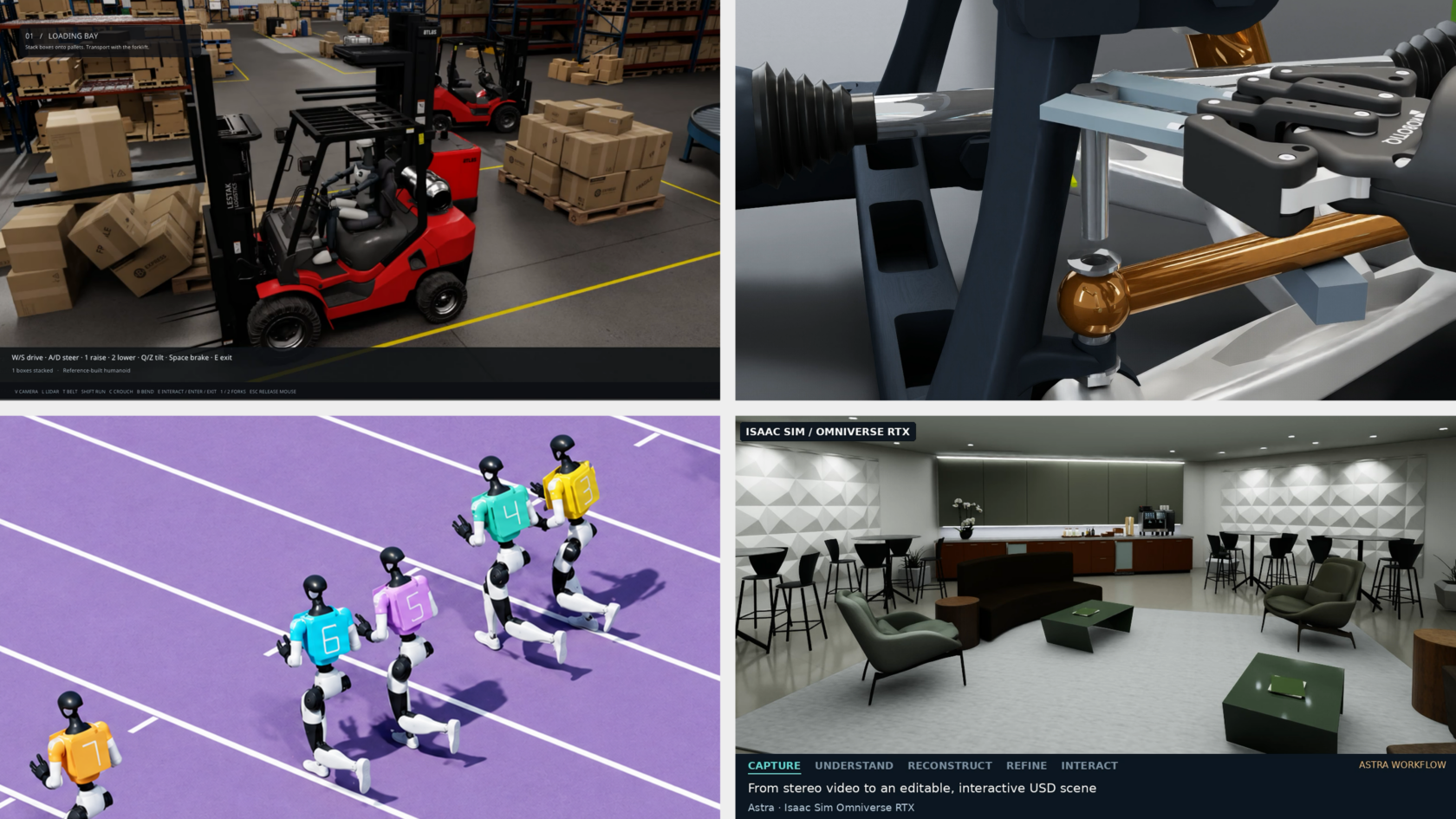
SummaryNVIDIA showcases six developer projects featuring a frontier AI agent named 'GPT-6 Astra' that writes code via natural language instructions to call Omniverse's GPU-accelerated physics, rendering, and USD libraries. In these projects, the agent builds simulation applications such as reconfigurations, gas turbine digital twins, warehouse stress tests, and robot cable routing demos. |
Why it mattersThe article positions AI agents as a new 'glue' layer between developer intent and heavy simulation stacks. This approach could potentially lower the barrier to building physical AI test environments in robotics, energy, and logistics. If the workflow is generalized, teams can progress much faster than manually coding Omniverse scenes for scenarios like fault injection, layout changes, and scaling. This compresses the cycle from design to validation. |
Highlights- All demos are prototypes. In the CAD-to-SimReady transition section, it is explicitly stated that physics properties are 'not calibrated against a real robot.' In the warehouse test, performance hits a wall when the scene size doubles.
- The 'AI agent' here is essentially an LLM generating Python/USD code that calls NVIDIA's own APIs (ovrtx, ovstage, ovstream, Isaac Lab). The intellectual workload, such as defining test procedures, selecting solvers like Cantera/SciPy, and reviewing renders, remains with the human developer.
- The real ecosystem moat is the SimReady Central Library, which contains over 2,000 USD assets from OEMs. Even if the agent is a useful front end, value accrues to those who own the asset and physics property pipeline.
|
Critical takeRead as marketing copy, the article conflates the statement 'an LLM writes ready-made code calling our SDKs' with the claim that 'AI agents are building simulations.' All examples run on NVIDIA hardware with NVIDIA libraries. There is no independent benchmarking, and no error state analysis beyond a single acknowledged slowdown. The article cuts off mid-sentence, indicating it was published as a placeholder for a long-form promotion rather than a comprehensive technical report. |
This critique was written by the local AI model
Qwen3.8-27B. I chose the story; I do not review each critique before it is published.