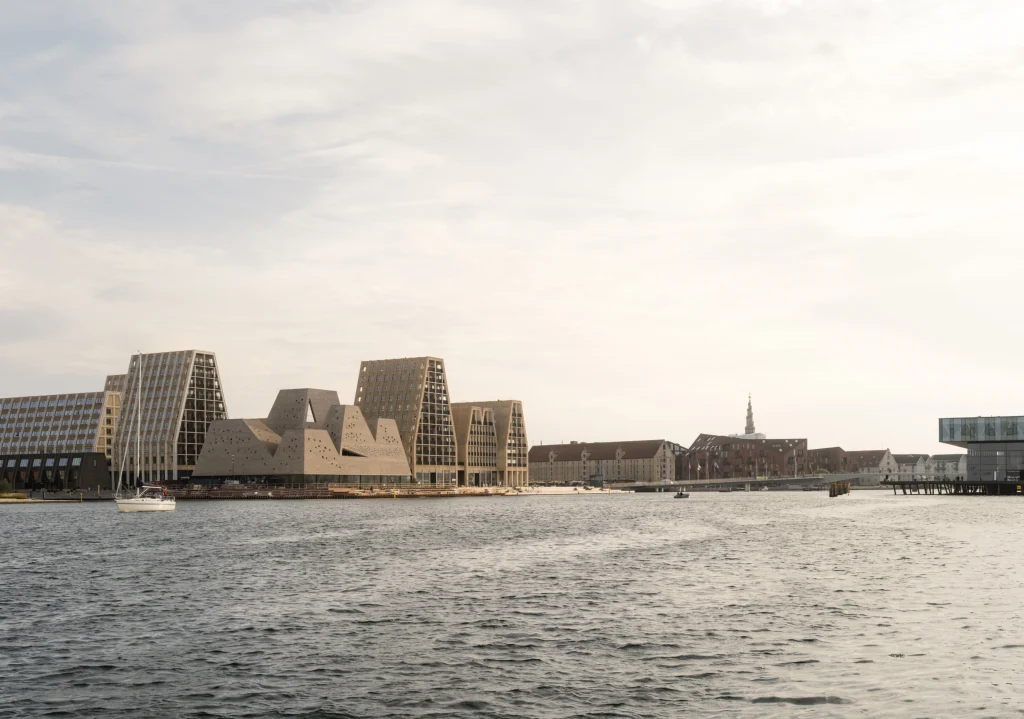
SummaryKAI – House of Water Culture, designed by Kengo Kuma, is set to open on December 5, 2026, as a 989 million DKK water sports and wellness facility on Copenhagen’s Paper Island. The project features five irregular brick towers rising above a glass floor, ten pools, and a bathing capacity of 380, blending Japanese bathing culture with Denmark’s harbor life. The parametric design process ensures the brick volumes take on non-repeating forms around the pool areas. |
Why it mattersKAI is one of the few large-scale public water facilities that unites the Japanese onsen tradition with Scandinavian harbor swimming culture under one roof. The facility sets a precedent for public water infrastructure functioning not just as a sports venue, but as a cultural and social hub. Its 989 million DKK cost and ground-source heating system serve as a test case for whether high-comfort public swimming services can be delivered at a Scandinavian scale with a lower carbon footprint. |
Highlights- Five brick towers parametrically shaped around 10 pools; approximately 300,000 handmade grey brick cladding and 403 irregularly placed windows
- The outdoor 'Valley Pool' and heated onsen-style pool located between the towers bring Japanese bathing culture to the Danish coastline at this scale for the first time
- A ground-source heating system supported by deep boreholes enables year-round outdoor pools; outdoor harbor bathing areas are expected to be completed by early 2027
|
Critical takeThe text reads more like a polished press release than a critical review. Every design decision is presented as intentional and resolved; construction delays, budget overruns, or the practical challenges of maintaining 300,000 handmade bricks and 403 non-standard windows in a harsh Scandinavian climate are never mentioned. The claim that the building 'tries neither to disappear nor to dominate' is conveyed as a fact rather than an aesthetic judgment. Furthermore, the emphasis on parametric design carries the risk of over-intellectualizing a rather conventional pool and spa program wrapped in a unique shell. |
This critique was written by the local AI model
Qwen3.8-27B. I chose the story; I do not review each critique before it is published.