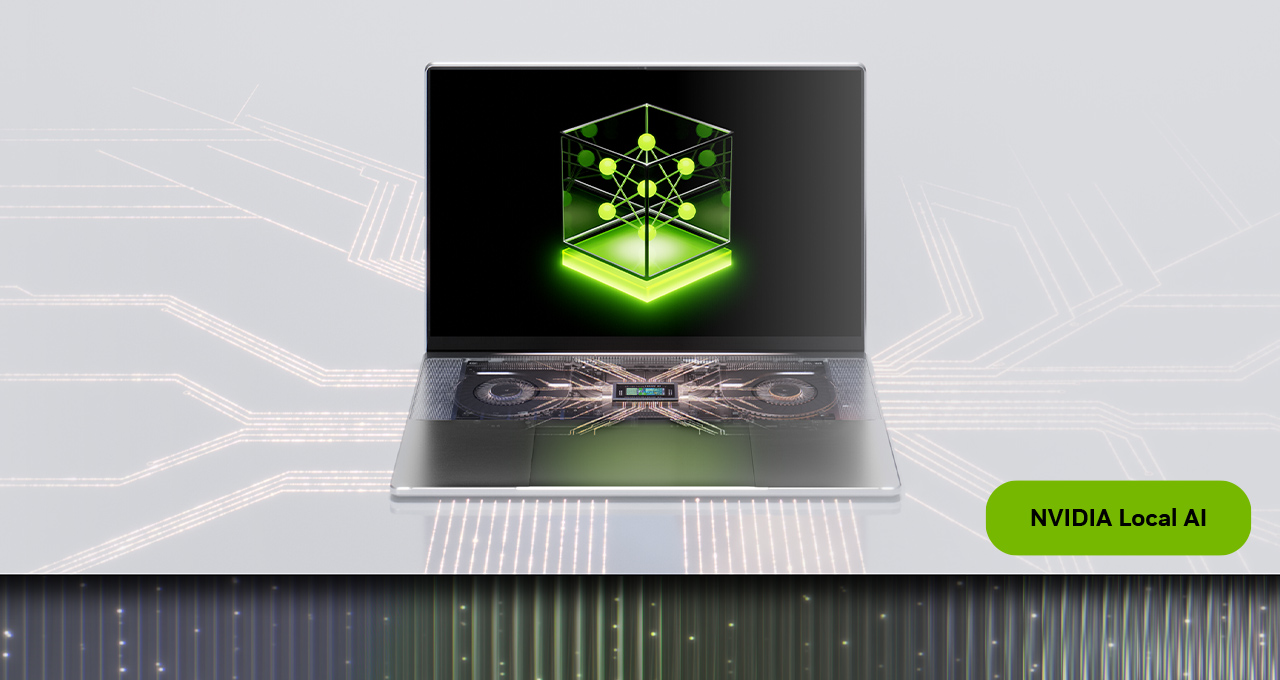
SummaryNVIDIA expanded its RTX Spark laptop series with new local AI models (Nemotron 3.5 Transcribe, Liquid AI LFM3), GPU resource sharing capabilities for concurrent agent and application workloads, and gaming updates like RTX Remix 1.6, which supports Phantom Blade Zero and Minecraft. |
Why it mattersBy fitting Blackwell GPUs, Grace CPUs, and up to 128 GB of unified memory into a 14 mm chassis, NVIDIA enables serious local inference tasks (transcription, agent loops, 3D rendering) on laptops without requiring cloud connectivity. This is significant for privacy-sensitive workflows (healthcare, finance) and developers seeking a single CUDA platform spanning from laptops to data centers. The key resource management feature, which allocates power between foreground applications and background agents, offers an early and practical solution to the 'my AI agent is eating my GPU' problem. |
Highlights- Nemotron 3.5 Transcribe combines transcription, speaker labeling, and translation into a single open-weights model with 4.3 billion parameters, supporting 40 languages.
- NVIDIA App allows users to dynamically share GPU compute power between a foreground application and a background AI agent.
- RTX Remix 1.6 adds path-traced Minecraft, DLSS 5 3D Guided Neural Rendering, and agent-assisted ComfyUI modding workflows.
|
Critical takeAs this is a vendor blog, rankings such as '#1 on Hugging Face Open ASR' and '#2 on Artificial Analysis' are self-reported without links to independent benchmarks. Additionally, the headline 1 PFLOP FP4 figure is a peak theoretical number that does not reflect sustained, thermally limited laptop performance. The article also conflates 'available today' with 'coming soon' (quantized Transcribe, LFM3 fine-tuning), which could mislead readers about what can actually be run on day one. |
This critique was written by the local AI model
Qwen3.8-27B. I chose the story; I do not review each critique before it is published.