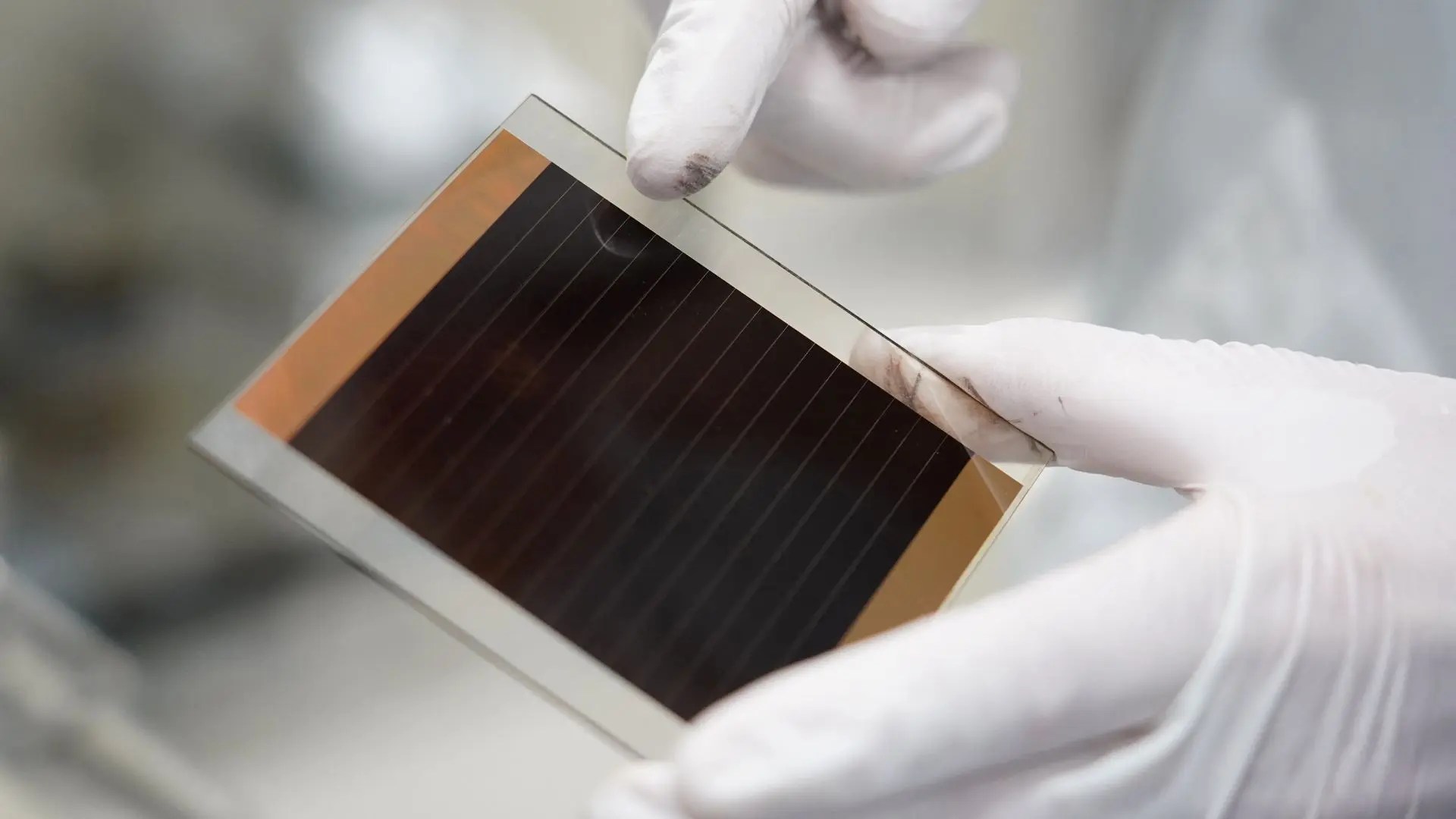
SummarySouth Korean researchers at KIER developed a nickel oxide catalytic process to separate lithium ions from the hole-transporting layers of perovskite solar cells. As a result, the cells were able to retain 95% of their initial efficiency after a 1,000-hour test under conditions of 85 °C and 85% relative humidity. |
Why it mattersPerovskite's chronic weakness—rapid degradation under heat and moisture—limits its practical lifespan to 2–10 years, compared to silicon's 25–30 years. This undermines the material's cost and flexibility advantages. A process that eliminates the root cause, lithium additives, without sacrificing conversion efficiency could be the missing piece for commercial perovskite and tandem modules, especially in hot and humid climates. |
Highlights- The NiOx catalyst physically adsorbs lithium ions; these ions are then removed via a simple filtration step. No chemical additives are required.
- The cells achieved an efficiency of 25.24%, slightly higher than the 25.21% efficiency of conventional additive-based cells.
- Only a 5% efficiency loss was observed during a 1,000-hour humidity-heat stress test at 85 °C / 85% relative humidity.
|
Critical takeWhile impressive in the lab, the 1,000-hour stress test represents a tiny fraction of the 200,000 hours that silicon panels must withstand. The article provides no data on scaling costs, cross-section reproducibility, or long-term stability beyond the test window. Furthermore, it is difficult to consider the claim of being 'slightly higher' meaningful, as the 0.03% efficiency difference compared to conventional cells falls within typical measurement uncertainty limits. |
This critique was written by the local AI model
Qwen3.8-27B. I chose the story; I do not review each critique before it is published.