 Amygdala mediates interbrain alignment in social dilemmasRead the article English (automatic translation) |
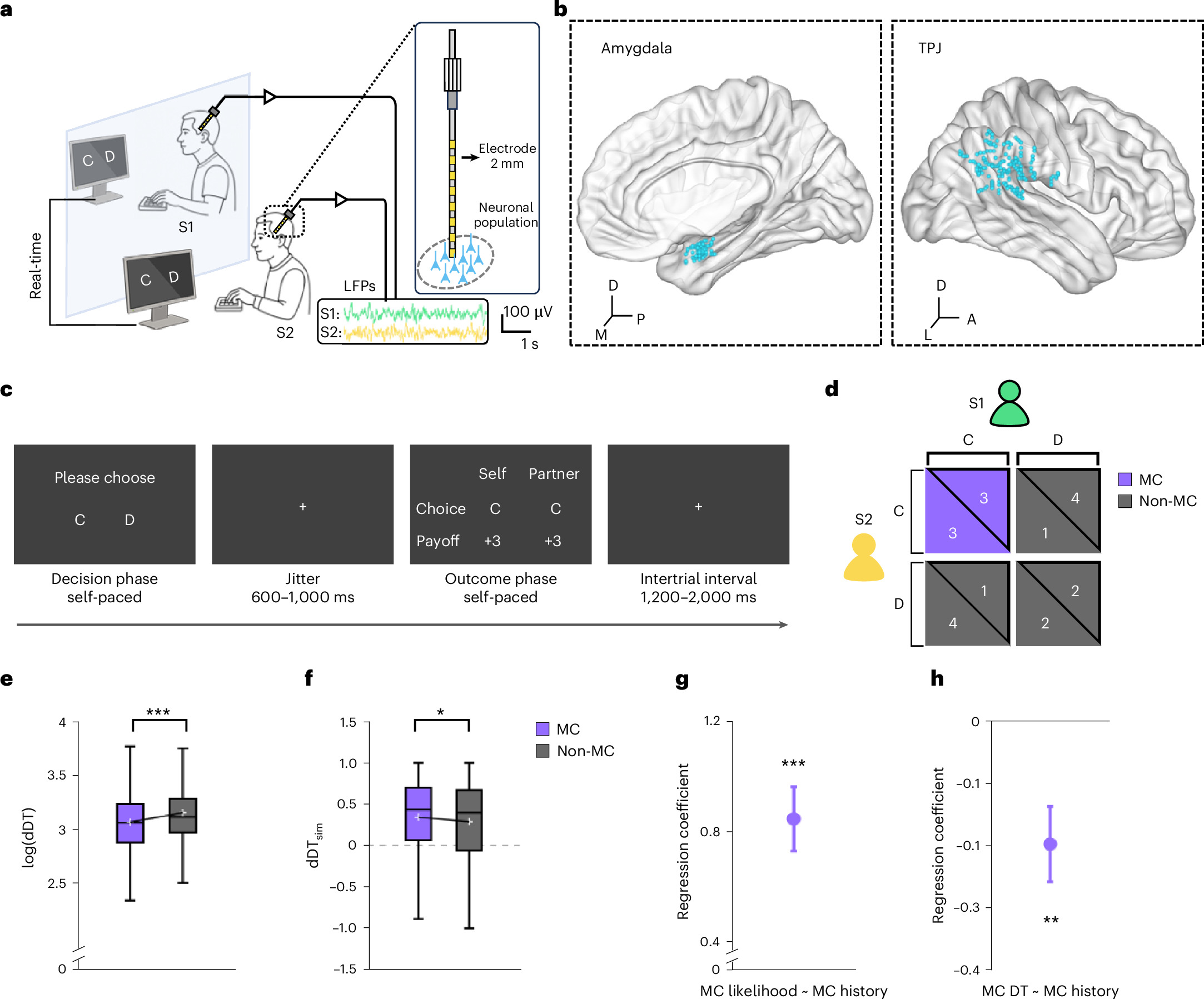
SummaryThe study identified an amygdala-mediated 'simulation-to-decision' cascade in a real-time, iterated prisoner's dilemma experiment using simultaneous intracranial EEG data from pairs of epilepsy patients. In this cascade, inter-brain spectral alignment (IBRA) emerges selectively only during mutual cooperation and follows model-based forward predictions of the partner's intent. This prediction is then linked to the individual's own decision via θ–γ coupling. |
Why it mattersCooperation has long been modeled as an internal, isolated computation. This study provides direct intracranial evidence that two interacting brains enter a measurable, frequency-based alignment state. This state is both necessary and predictive for cooperative outcomes. If the findings are replicated, the social decision-making process will be reframed as a genuinely dyadic neural process. Additionally, it will offer a mechanistic explanation for why some individuals coordinate under uncertainty while others avoid cooperation. |
Highlights
|
Critical takeBecause the sample is a small clinical cohort of epilepsy patients, generalizability to the healthy population is uncertain. Furthermore, the iEEG design is inherently correlational. The causal direction (does amygdala alignment *drive* cooperation or merely *accompany* it?) has not yet been tested. Grand claims like 'redefining cooperation' also go beyond what a single-task, two-person paradigm can establish. |