 Google introduces code that cuts quantum error correction costs by 30xRead the article English (automatic translation) |
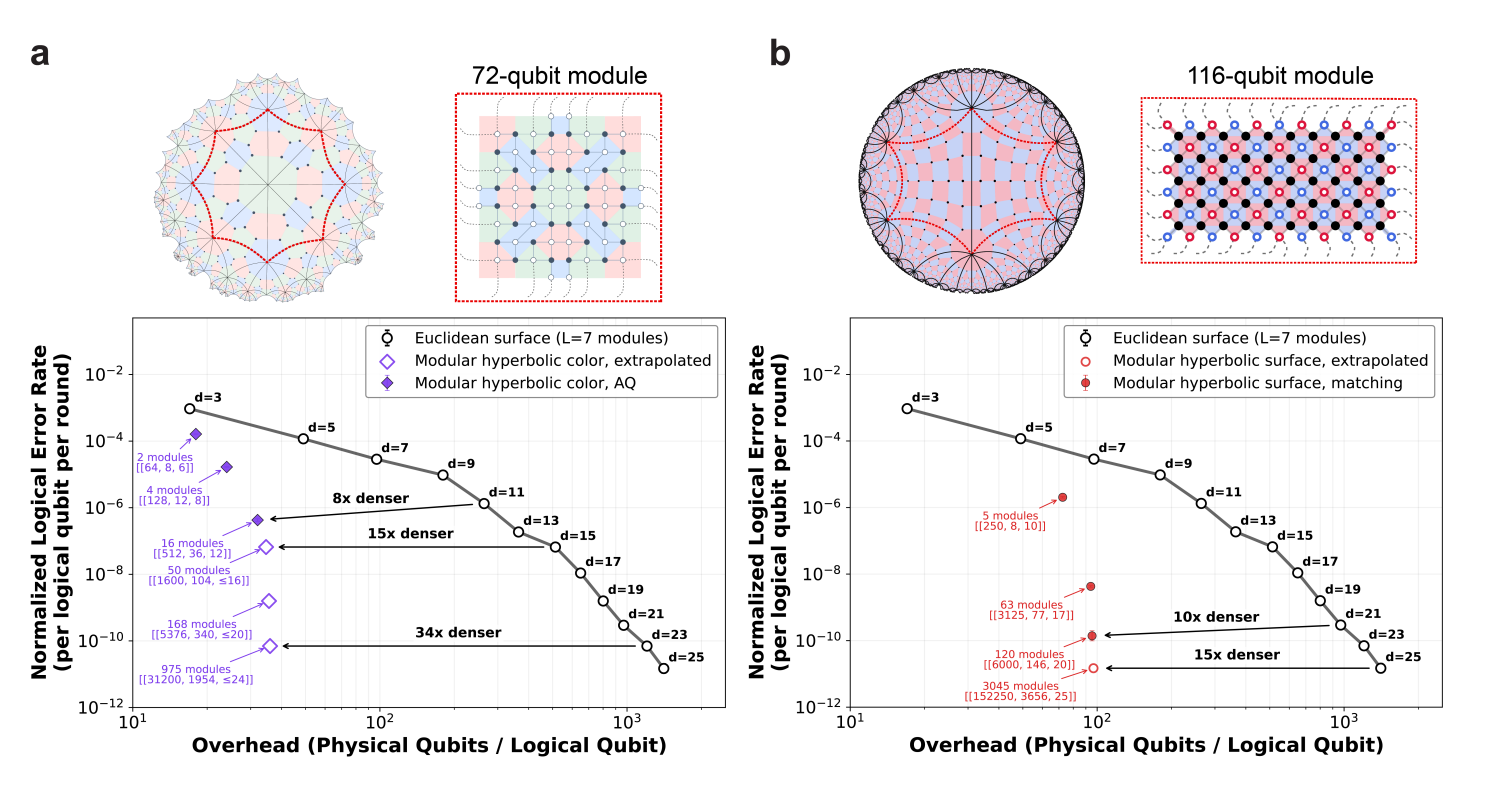
SummaryGoogle Quantum AI, DeepMind, and MIT presented a modular quantum error correction architecture using small, planar chips (~72–116 qubits) connected via hyperbolic tiling geometry. Circuit-level simulations indicate that this design reduces the physical qubit overhead by more than 30 times compared to standard 2D surface codes. |
Why it mattersQuantum error correction (QEC) overhead is one of the primary bottlenecks preventing practical fault-tolerant quantum computers. A 30-fold reduction in the number of physical qubits required per logical qubit could dramatically shrink the hardware scale needed for functional machines. The modular, flat-chip design also eliminates the dense long-range wire crossings that challenge monolithic qLDPC implementations, making manufacturing and interconnection processes more feasible. |
Highlights
|
Critical takeThe highlighted 30-fold ratio is solely a simulation result compared to surface codes. The Two-Gross Bivariate Bicycle Code already achieves a 48 physical/logical qubit ratio on a single chip; therefore, the real advantage is modest (36 vs. 48) and comes at the cost of inter-chip linkers whose long-term reliability and efficiency are unproven. As an arXiv preprint lacking experimental validation, this architecture is a promising draft rather than a proven engineering solution. |