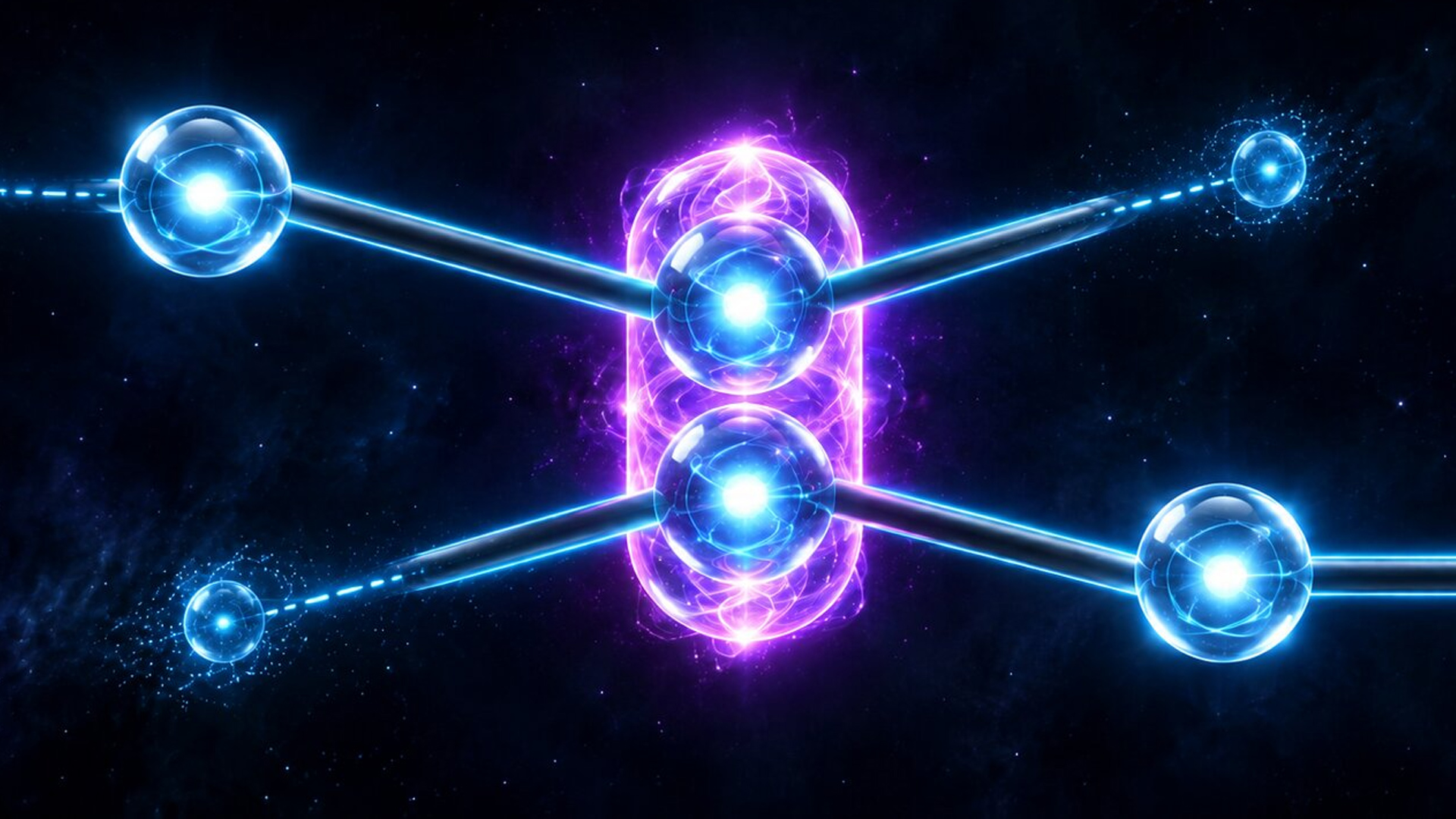
 Chinese researchers achieve 13-qubit entanglement without destroying photonsRead the article English (automatic translation) |
SummaryResearchers at Tsinghua University demonstrated the deterministic and non-destructive fusion of microwave-photon entangled states using a superconducting circuit and quantum non-demolition measurement. The study achieved genuine 13-qubit entanglement and was published in Nature Physics. |
Why it mattersConventional photonic fusion is probabilistic and destructive, creating a bottleneck for scaling up graph states in measurement-based quantum computing and quantum networks. A deterministic, programmable, and non-destructive fusion principle directly addresses this bottleneck by allowing researchers to link smaller resource states into larger, reconfigurable networks without losing photons. If scalable, this approach could form the foundation for quantum error correction architectures where both the size and connectivity of graph states are critical. |
Highlights
|
Critical takeUsing 13 microwave-photon qubits in a superconducting laboratory setup represents a meaningful proof of concept. However, the authors acknowledge that device fidelity, photon generation efficiency, and detector performance still fall below practical thresholds. Labeling this work as 'the path to scalable quantum computing' risks overstating a single deterministic fusion gate demonstrated at a modest scale. |