 Sensory prediction signals in the human superior colliculus confirmedRead the article English (automatic translation) |
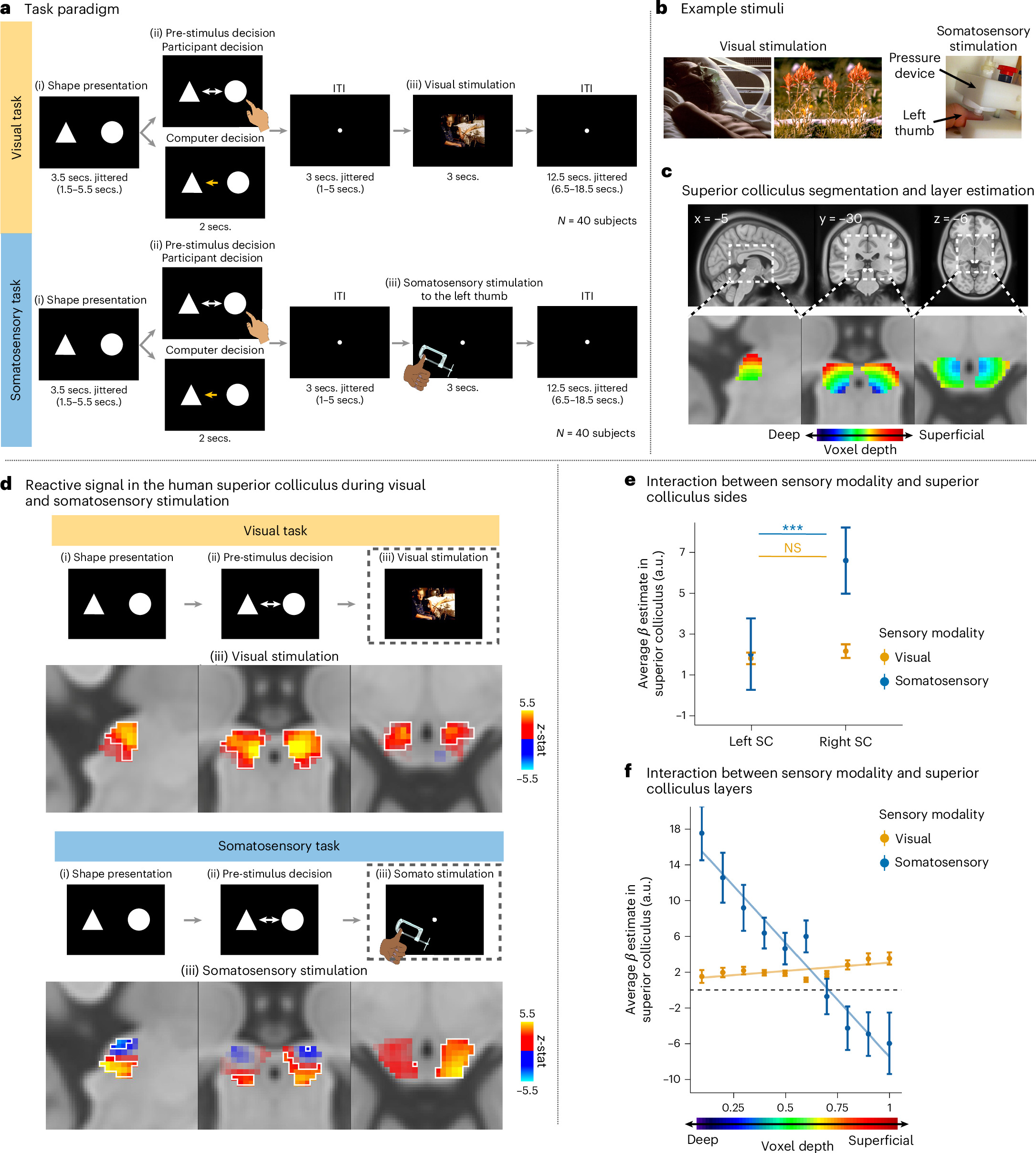
SummaryUsing 7 Tesla fMRI data (N=80), the study reveals that the human superior colliculus exhibits modality-specific, layer-based BOLD responses not only to visual and somatosensory stimuli but also during the pre-stimulus anticipation window. This finding is consistent with predictive processing and allostasis frameworks. |
Why it mattersThe superior colliculus has long been characterized as a reactive sensory integration center based on single-neuron studies in non-human animals. This study provides the first high-resolution human evidence that the structure encodes *expected* sensory inputs along its laminar gradients. This finding links the midbrain structure to the broader predictive/allostatic narrative, demonstrating that the brain's predictive mechanisms extend far beyond cortical association areas. |
Highlights
|
Critical takeThe hemodynamic delay of the BOLD signal (~2 seconds) makes it difficult to claim that the superior colliculus 'anticipates' in the narrow, millisecond-scale sense implied by the allostasis/predictive coding literature. The effect may reflect top-down preparatory gating rather than true forward modeling. Furthermore, the between-groups design (visual n=40 vs. somatosensory n=40) and the simple neutral/avoidance stimulus paradigm limit the generalizability of the 'prediction' claim to more natural, continuously updating sensory contexts. |