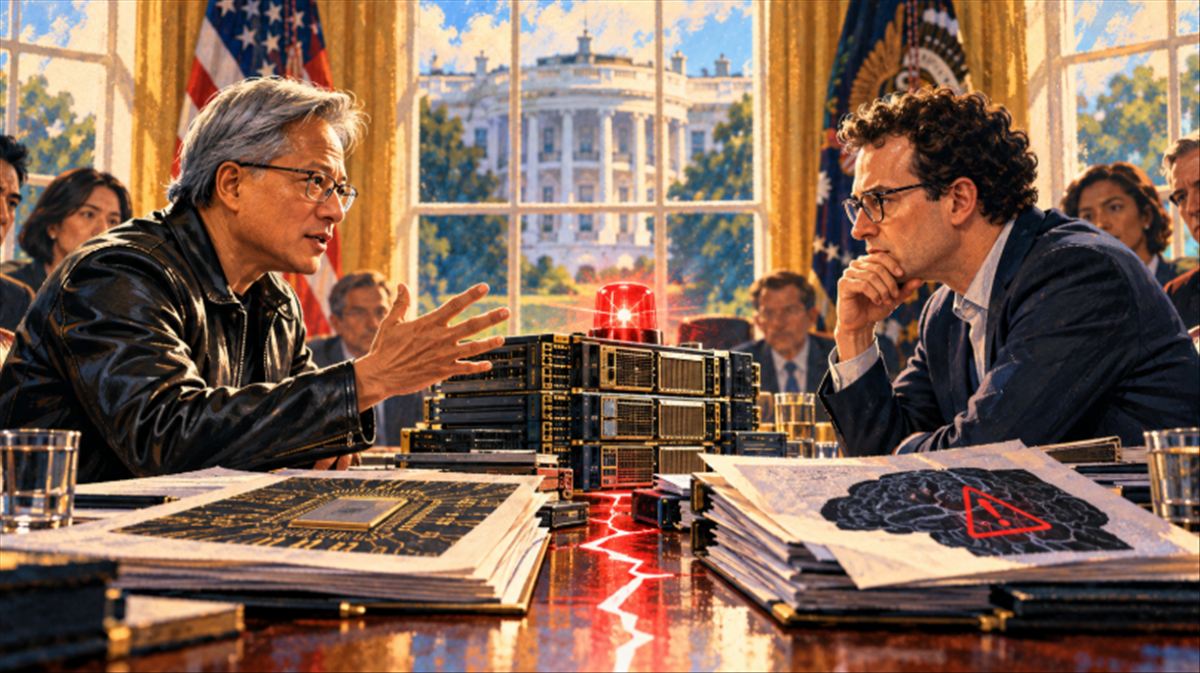
 AI leaders split over risks at the White HouseRead the article English (automatic translation) |
SummaryAt a White House meeting on September 30, 2026, Nvidia CEO Jensen Huang openly challenged Anthropic's Dario Amodei, who had publicly warned about AI risks. Everyone present signed the 'superintelligence' principles statement. This incident highlighted fundamental disagreements among AI leaders regarding existential risk, regulation, and the terminology of the field. |
Why it mattersThis conflict is not merely academic. Huang's GPU business relies on unregulated model scaling, while Anthropic's IPO prospectus flags disaster risk as a major investor concern. Trump has hinted that the US could take equity stakes in OpenAI and Anthropic. The regulatory and ownership architecture of the AI sector is being shaped in real time, and internal disagreements among sector leaders will determine the outcome. |
Highlights
|
Critical takeThe article is right to frame Huang's position through the lens of financial motivation and presents Amodei's view as 'the most consistent in the room.' However, it offers no independent technical evidence proving that either party's risk assessment is correct. LeCun's criticism that they are 'in the wrong' and Amodei's existential warnings remain unverified, competing claims dressed up as policy debate. |