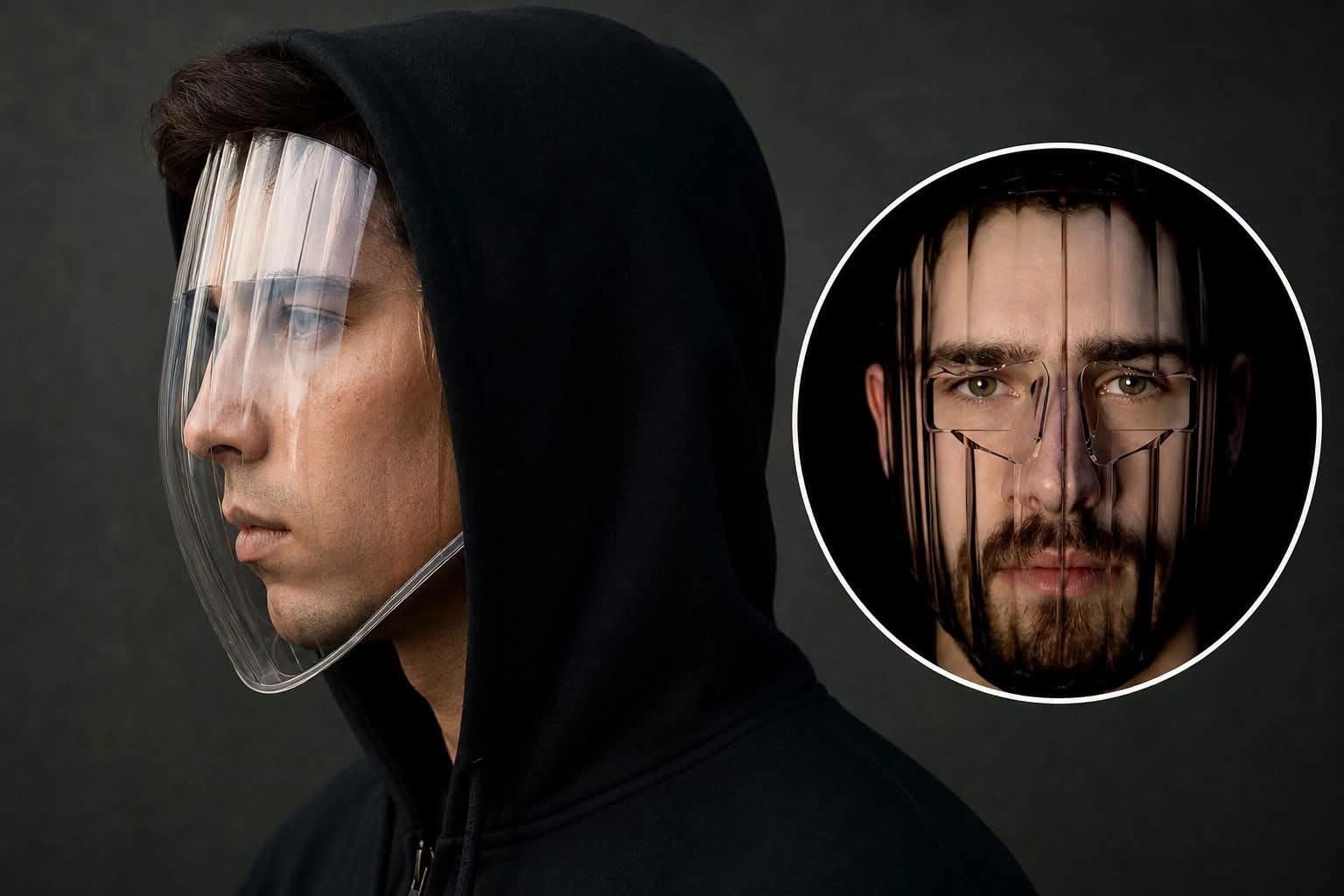
 Design of a transparent mask that deceives facial recognition systemsRead the article |
SummaryDutch designer Jip van Leeuwenstein's transparent, tilted mask disrupts the geometric landmarks that facial recognition algorithms rely on. As a result, the wearer becomes difficult to match in databases, while their expression remains fully legible to the human eye. |
Why it mattersBiometric surveillance is expanding beyond security sectors into airports, retail, and public streets. For individuals who do not control cameras or databases, this mask serves as one of the few limited physical countermeasures available. It reframes privacy not just as a legal issue, but as a material and design challenge. While resisting algorithmic cataloging, it preserves the right to be seen by humans. |
Highlights
|
Critical takeThe text reads as a news piece for design media rather than a technical evaluation. It lacks accuracy drop rates, names of specific systems tested, or angle-specific metrics. Consequently, the claim that it 'works from multiple angles' cannot be independently verified from the text. The article also exaggerates a limited, non-commercial, and unadversarially tested design exercise as a 'declaration of freedom.' |