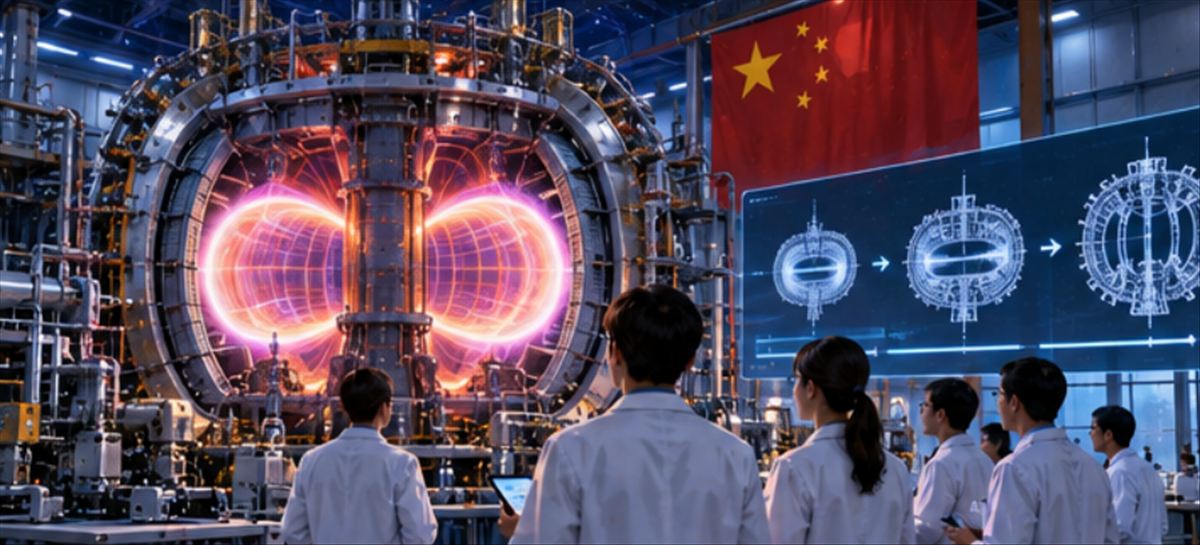
 China unveils HL-4, the first continuous fusion reactor with high-temperature superconductorsRead the article English (automatic translation) |
SummaryChina unveiled the conceptual design of the HL-4 tokamak at the Shanghai Fusion Energy Conference. The device is designed to use high-temperature superconducting (HTS) magnets, overcoming the limitation of previous systems that relied on copper windings and were forced to settle for short pulses. This enables a goal of continuous, uninterrupted operation. |
Why it mattersThe transition from pulsed to continuous operation is the most critical engineering prerequisite for a commercially viable fusion plant. Therefore, validating HTS magnets under 25 tesla in real fusion conditions represents a genuine leap forward. This move also highlights China's effort to bring superconducting magnets, a critical supply chain component, under its own end-to-end control. This approach aims to reduce geopolitical dependencies, similar to those already shaping the semiconductor and battery sectors. |
Highlights
|
Critical takeThe text reads more like a state-aligned narrative than an independent engineering assessment. While the announcement of a conceptual design is celebrated, it implies near-term feasibility. Furthermore, no critical review is provided on whether 25 tesla continuous operation at the scale required by HL-4 has actually been demonstrated. The same HTS approach is still in the proof-of-concept stage, as evidenced by CFS's SPARC project, which has not yet achieved its first plasma. |