 Single brain implant decodes simultaneous speech and gestures in paralyzed patientsRead the article English (automatic translation) |
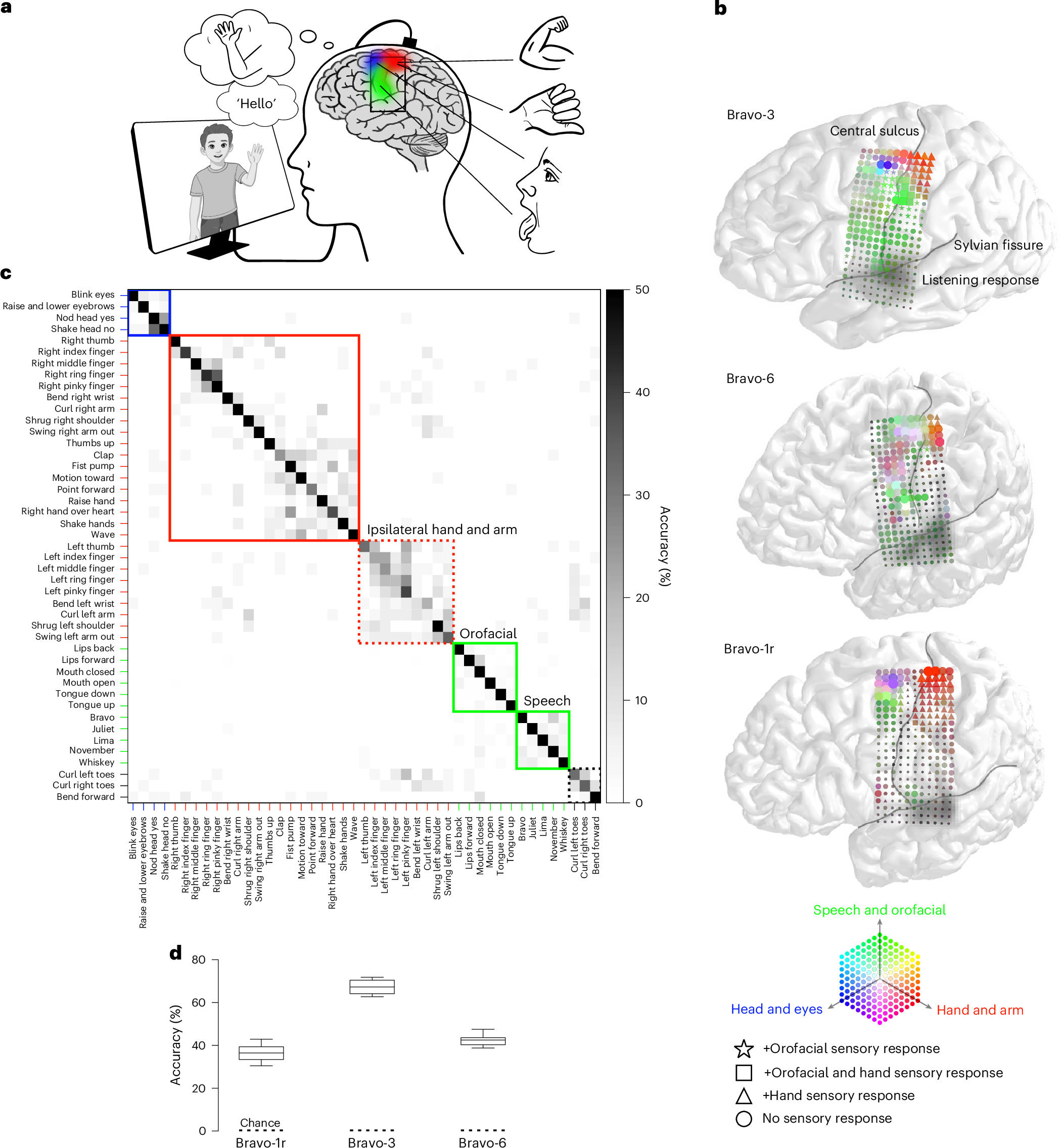
SummaryUCSF researchers demonstrated that a single high-density ECoG cortical implant could simultaneously decode both speech and hand movements in three participants with paralysis. This allowed participants to control a virtual avatar by combining verbal and non-verbal outputs. Decoders trained on both isolated and simultaneous behavioral data showed improved performance across different contexts. |
Why it mattersNatural human communication is inherently multimodal, with speech almost always accompanied by gestures. However, previous brain-computer interface (BCI) studies treated these channels in isolation. Demonstrating that a single implant can support control of multiple effectors without additional hardware is a practical step toward clinically useful, low-burden communication prosthetics for patients with ALS and stroke. This finding also supports the view that simultaneous data should be included in the training process. This insight can be generalized to other multi-effector BCI designs. |
Highlights
|
Critical takeWith only three participants and a virtual avatar task, the claim of 'natural communication' remains a goal rather than a proven reality. Robustness in real-world conditions, latency under speech pressure, and generalization to new sentence or gesture vocabularies have not yet been tested. The spatial resolution of ECoG surface signals is limited. It remains unclear whether the same simultaneous decoding gains are valid or necessary in higher-density intracortical arrays, where cross-talk between speech and motor regions is already documented. |