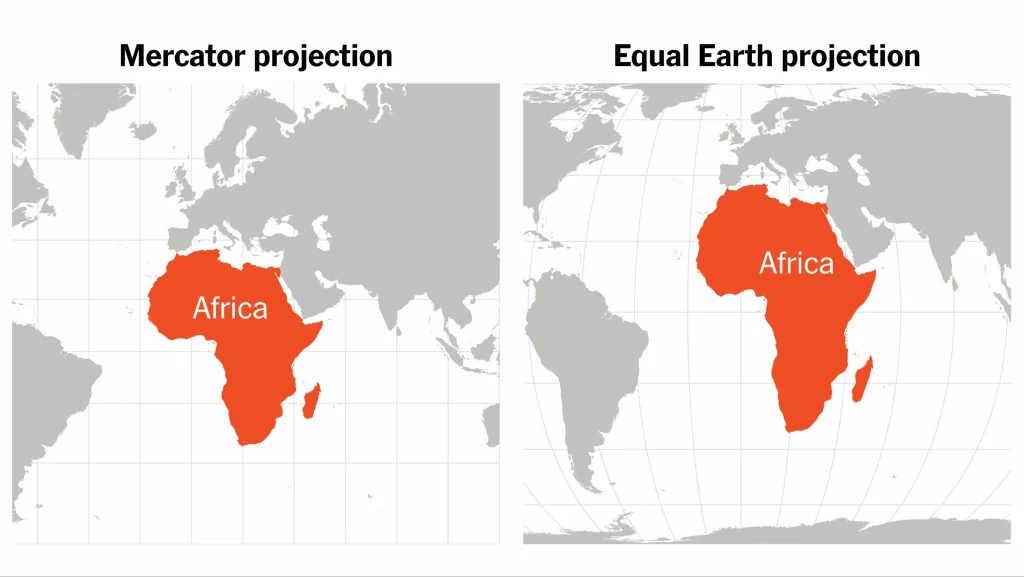
 UN votes to replace Mercator projection with Equal EarthRead the article |
SummaryThe UN General Assembly, in September 2026, called on member states to transition from the Mercator projection to the Equal Earth equal-area projection in educational and institutional maps by a vote of 164 to 1. Led by Togo and the African Union, this non-binding resolution does not ban Mercator or mandate changes to private software. The target scope includes textbooks, public maps, and media platforms. |
Why it mattersMaps are fundamental mental models through which billions of people internalize the relative size, power, and importance of regions. A coordinated shift in the default projection could shape geographical literacy for generations. The near-unanimous vote demonstrates that map representation has evolved from a technical choice into a diplomatic and equity issue. The US emerged as the sole dissenting voice. This also highlights that a 450-year-old navigation tool remains dominant in visual culture despite having outgrown its original purpose in everyday contexts. |
Highlights
|
Critical takeThe article's framing, using phrases like 'silently misleading humanity' and 'breaking 450 years,' presents a well-understood mathematical trade-off as a form of deception. This is an editorial opinion, not a news-worthy finding. Mercator's distortion is a documented feature of its design, not a conspiracy. Furthermore, the article fails to present counter-arguments from the US or abstaining states, analyze what 'cognitive justice' means in practice, or provide a concrete timeline or implementation mechanism. It leaves the reader with a victory narrative rather than a concrete policy assessment. |