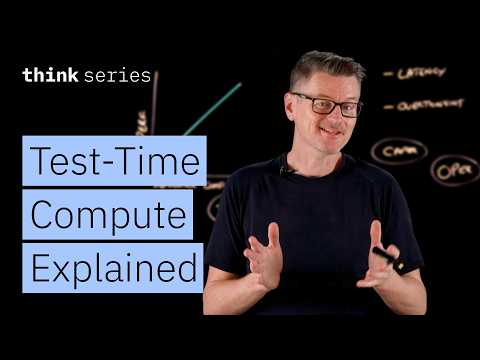
 Why AI Models Pause to Think: Test Time Compute ExplainedWatch with Turkish subtitles |
SummaryA YouTube explainer video treats test-time compute as a second scaling axis alongside model size. It examines methods such as chain-of-thought reasoning, tree search, and self-consistency. Citing a 2024 Google DeepMind paper, it shows that a 3-billion-parameter model can outperform a 70-billion-parameter model on difficult math problems by leveraging test-time search. |
Why it mattersThe video reframes the 'bigger model = better' narrative by demonstrating that allocating computational power at inference time can close or even reverse the gap between small and large models on reasoning tasks. This has direct cost and latency implications for anyone deploying LLMs, as test-time compute represents a variable per-query cost (OPEX) rather than a one-time capital expenditure (CAPEX). Understanding the trade-offs between fast single-pass and deliberate inference paths—such as latency, token billing, and overthinking—is essential. |
Highlights
|
Critical takeThe video presents the result of a 3B model outperforming a 70B model as a near-universal finding while ignoring the narrow benchmark conditions and the high latency/cost multipliers that make it impractical for most production workloads. It also treats adaptive routing as a settled engineering solution, whereas in practice, optimal per-query compute allocation remains an open, task-dependent research problem. |