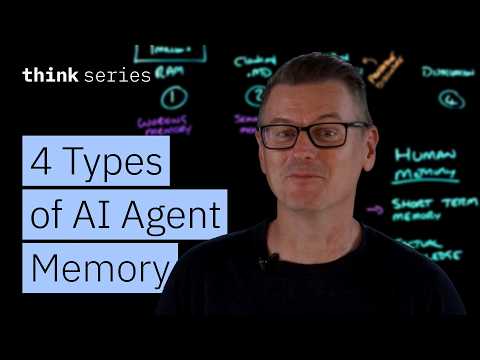
 The Four Types of Memory Every AI Agent NeedsWatch with Turkish subtitles |
SummaryA YouTube explainer video examines the four types of memory in AI agents—working, semantic, procedural, and episodic—by referencing Princeton's CoALA framework. It presents Claude Code's Claude.md file and the 'agent skills' open standard as concrete examples. The video argues that what distinguishes a true agent from a chatbot is not just model capability, but memory architecture. |
Why it mattersAs agentic systems move beyond demos into production environments, most real-world failures occur at the memory layer: repeated errors, context bloat, and a lack of cross-session learning. A clear classification of the four memory types provides engineers with a shared terminology to diagnose why an agent keeps repeating the same tasks or misses project rules. This classification also highlights the still-unsolved 'forgetting' problem, which will determine whether agents truly improve over time or simply accumulate noise. |
Highlights
|
Critical takeThe video reads more like confident popularization than critical analysis. While referencing CoALA and the 'agent skills' open standard, it does not question the assumptions underlying these structures. Although the episodic memory section points to the forgetting problem ('what should be deleted?'), it offers no concrete mechanism or trade-off framework. The distinction between a chatbot and an agent is also taken as self-evident without discussion. The viewer is left with a neatly organized four-box schema, but without a sense of where the real engineering challenges lie. |